Showing posts with label farce. Show all posts

23.1.22

A Film a Week - Herd Immunity / Onbagandar

 previously published on Asian Movie Pulse
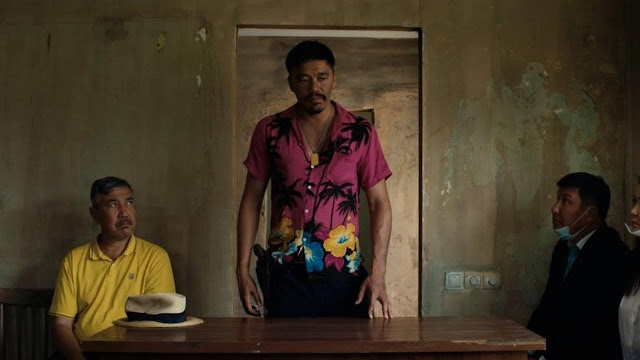

In the past 20 months, we have all learned what an expression “herd immunity” means for the reasons well known. The Covid-19 pandemic has come even to the most remote places of the world, like the village of Karatas in Southern Kazakhstan which serves as the location and the source of inspiration (usually in the form of a metaphor for a hotbed of corruption) for most of the work by a Kazakh filmmaker Adilkhan Yerzhanov. Oddly, this not Yerzhanov’s first “epidemic rodeo”, as some could remember “The Plague in Karatas Village” (2016), but “Herd Immunity” still comes at the right time. Like Yerzhanov’s previous film, “Ulbolsyn”, “Herd Immunity” premiered at Black Nights Film Festival where we had the chance to see it.

Our unlikely hero is Selkeu (Yerzhanov’s regular Daniyar Alshinov), one of the two Karatas sheriffs, the other being an ex-police officer Zhamzhysh (Nurbek Mukushev). Selkeu is from somewhere abroad (which is known from the recurring joke that the locals urge him to speak Russian, since his Kazakh language skills are poor) and lives there practically as a homeless person, but it does not prevent him to be a master (or at least an adept) negotiator when it comes to keeping the peace between the locals themselves and with the outside world for which he keeps scheming and extorting money, usually to no tangible success.

However, the trouble comes from the outside world, both in the form of the pandemic and in the form of the real representatives of the law from the city, including Selkeu’s ex-wife Turiya (Assel Sadvakassova of “Ulbolsyn” fame) and her new husband, a high-ranking police official Gurbeken (Yerzhan Zhamankylov) who come to town on the order to apprehend the local barn owner who apparently refuses to go to isolation. For that, they need Selkeu’s help and they are ready even to pull their strings and arrange a transfer for him to the city. But that minor incident is just an introduction to the larger sting operation whose target is a local mobster and aspiring dance stage director Bula (played by a real-life filmmaker Bolat Kalymbetov) and the question is for how long would Selkeu be able to scheme his way to keep everybody satisfied and his mere existence sustainable.

Herd Immunity” operates in the same world as other Yerzhanov’s films, not just on the terms of location, but also regarding the details of the power structures in which the locals might be silly and stupid, but they are still powerful because the “system” they created is resistant to the interventions by the clueless outsiders, no matter how much power they are supposed to hold officially. Yerzhanov also manages to squeeze a tribute to his favourite filmmaker, Jean-Pierre Melvile, whom he quoted abundantly in his previous work, by keeping the poster for “Le cercle rouge” at the centre of one pretty long take for seemingly no reason.

The new thing, however, is the genre framework of a political satire that theoretically holds no brakes. Within the mentioned genre framework, some sorts of theatrics in acting are acceptable and work especially well in Yerzhanov’s playful directing style that usually relies on long, wide-angle takes from fixed position. The sense of directorial coding in which static shots stand for “business as usual” scheming and the camera movements signal some kind of emotional movement as Selkeu experiences some second thoughts also serve the purpose pretty well.

However, some of the subplots in the film go nowhere pretty fast and some of the moments and details are there seemingly only for the sake of the emphasis on the weirdness of the situation. The end result does not have much to do with the pandemic situation itself (which is not necessarily a bad thing), as it remains within the borders of a comedy/satire about a small town mentality that we have already seen times before, even among the ranks of Yerzhanov’s own work. It might not be as heart-felt as last year’s comedy “Yellow Cat”, as striking as the feminist thriller “Ubolsyn” and as intriguing as Yerzhanov’s earlier works, but “Herd Immunity” is still an interesting and worthy watch.

25.6.17

A Film a Week - Slack Bay / Ma Loute


What happened to Bruno Dumont, once the filmmaker behind the serious, cold, observant, almost misery porn-like art house films like Humanity, The Life of Jesus, Flanders, Hadewijch, Hors Satan and Camille Claudel 1915? Maybe he has found his artistic “true self” helming the amusing, absurdist murder mystery / child’s crime comedy mini-series Li’l Quinquin to which Slack Bay is connected in style, theme and location. Maybe it is just a phase that would culminate with the musical about Joan of Ark as a child called Jeannette that premiered in this year’s Cannes Directors Fortnight selection.

Slack Bay is a rare animal in modern, explanatory filmmaking: a mystery that completely reveals itself half an hour into the film, a comedy that is not all that funny (if it is funny at all), a love story that is not romantic, a farce about class and status in the manner of Monty Python absurdism meets the silent films of the era (the story is set in Belle epoque, before the World War I) and French physical comedy that relies heavily on gags and sound design full of squeaking, creaking and crackling noises. Let us just say it is not for everyone and it takes time to be absorbed.

First, we have three narrative lines in the story. The “mystery” one is carried by an obese police investigator Machin (Didier Després) and his skinny, ginger-haired buddy / lackey Malfoux (Cyril Rigaux). They wear matching Laurel and Hardy uniforms and are investigating the case of several tourists gone missing from beaches of the titular bay on French northern coast.

Then we have the family of inbred aristocrats van Peteghems that seem to have trouble to tie their own shoes that have a ridiculous summer house on the top of the hill overlooking the bay. The father André (Fabrice Luchini) is a hunchback marveling at the beauty of the nature and the progress of the modern, industrialized world. His cousin/wife Isabelle (Valeria Bruni Tedeschi) is hardly able to stand on her feet, but keen to yell at the poor servant girl and at the children. There is also the “funny” uncle Christian (Jean-Luc Vincent) prone to getting lost in various places and talking the deep-sounding nonsense in both English and French. And the operatic aunt Aude (Juliette Binoche) is a real piece of work, like Florence Foster Jenkins even less aware of the lack of a talent and with some strange religious ideas. The kids seem uninterested in anything but running wild on the beaches. And, in the end, there is Billie (a newcomer Raph), André’s gender-bending niece who exchanges the whigs, trousers and dresses so often so it is a mystery is it a girl that occasionally dresses as a boy or the other way round.

Finally, the Bruforts, family of “have-nots” also lives in the bay. They are mussel-gatherers led by the patriarch nicknamed Eternal (non-professional Thierry Lavieville) with a lot of mischievous kids in matching bluish rags whose names sound like random nicknames. Eternal who got his name for saving over a hundred people from drowning and his eldest son, the titular (in the original French title) Ma Loute (Thierry’s son Brandon), provide the services of crossing the bay for tourists. Sometimes they carry them in their own arms, sometimes they use a boat, sometimes they kill them to provide supper for the whole family. Often angry Ma Loute will fall hard for Billie in the fashion of forbidden romances...

The problem with Slack Bay is the fact that it goes nowhere fast. It is clear that Dumont is more interested in his characters than in a story of any kind, so the film looks like a series of one-note sketches stretching for too long. The real bummer with all that is that even the characters are not being developed, but exist as the same broad stereotypes and cartoons from the very beginning. Even the most normal and humane ones do, like Billie and Ma Loute whose attempt of romance, conceived as the emotional core of the film.

Which leads us to another major issue: Slack Bay has no center or anchor of any kind. The audience gets to know the villain in the investigation just under the investigators’ noses and can presume the unsuccessful outcome of it all. The love story is so basic and does not generate any kind of conflict between two self-absorbed families. Aristocratic morons, state buffoons and the angry peasants who hate the former two so much they would literally eat them serve well as a metaphor of class warfare going wild and as a potent punchline, but it is still not enough to wrap the whole film around it.

Still, there are some pleasures to be found in Slack Bay. First and foremost, French A-list actors play complete idiots with gusto and bravado, and that is fun to watch. Dumont also scores some broad laughs with his peculiar sense of humour. And the cinematographer Guillaume Deffontaines is nothing short of a miracle worker for occasionally turning the muddy swamp landscape into an insanely photogenic one, highlighting the contrast between the nature and the humans it supports.

Slack Bay is a well-done, glorified trash movie and it is obviously Dumont’s deliberate decision. Does it work? It is hard to say, some of the time, yes, but all the time, not really.