Showing posts with label violence. Show all posts

21.4.24

A Film a Week - Asche

 previously published on Cineuropa


Even before Elena Wolff’s sophomore feature, Asche, starts, the audience is warned that the film features certain things that might trigger them, such as drug and alcohol abuse – and, oddly enough, the city of Linz. Why the capital of Upper Austria should serve as a trigger for anyone remains a mystery, but this aspect also highlights the young filmmaker’s primary intention to provoke the audience however she sees fit. The film, however, did not premiere on home turf, but rather some 200 km away, at the Diagonale in Graz.

Asche is set in the circle of aspiring and up-and-coming artists from the budding Linz scene, and centres on three women who are part of an artistic collective whose performance we see early on, while we meet their partners at the afterparty following it. Lulu (the filmmaker herself) hooks up with Simeon (Thomas Schubert, of Afire fame), a self-confident photographer who proclaims himself to be an authentic genius and the alpha male of the scene. Their relationship is turbulent and based on shaky foundations, since he insists that it should be open while also acting like he owns her, but the question is how long his “muse” will be willing to put up with it. On the other hand, Anna (Selina Graf, collaborating with Wolff once again, after her 2022 debut, Para: Dies) tries to break away from the toxic romanticism of her boyfriend Felix (Simon Kluth), using a move to Berlin as an excuse, while she might also be interested in some much darker stuff that she can find in Linz. Finally, the seemingly idyllic relationship between Élise (Naomi Bah) and Emilia (Celine Meral) falls apart due to their conflicting ideas of closeness. And there is also Jakob (Nils Svenja Thomas), a non-artist, a potential stalker and maybe even an incel with whom Lulu starts conversing in the park…

Asche is a film drenched in excess, and all that foul language, cocaine and alcohol abuse, as well as the use of largely gratuitous nudity, are clearly aimed at provoking a strong reaction from the audience. In the dialogue department, the filmmaker tries to shine a spotlight on the toxicity of interpersonal relationships, even in artistic circles, that is enabled by the predominant patriarchal model, but she does so in a clumsy way that seems more like rambling than firmly pointing a finger at the problem. Even the third-act turn into the territory of revenge horror seems like a vague, underdeveloped idea and yet another attempt at shocking the audience.

Wolff tries to forge a new and unique visual language, but it often ends up somewhere between music-video aesthetics and an attempt at alternative arthouse cinema. First-time DoP Nora Einwaller sometimes opts for plainly odd angles that deform the actors’ features for no apparent reason (although her work still managed to persuade the festival jury to give her an award), while the editing by Alba Diaz is too choppy for a story that unfolds in two different timelines, presented simultaneously. In the acting department, Asche is also uneven, since the helmer casts herself in the main role so that she can expose herself, in every sense of the word. Apart from her, only Thomas Schubert and Naomi Bah play their characters with a bit of swagger, while the rest of the thesps end up being a tad bland in comparison. In the end, Asche can be seen as a striking movie, a bit like a punch to the eye, but it could benefit from more coherence.

18.12.22

A Film a Week - Wake Me / Zbudi me

 previously published on Cineuropa


Can anyone truly be reformed? Does life ever offer a chance at a clean slate? Can a person really get rid of their heavy hate-filled baggage? These are the questions to be aware of before watching the latest film by Croatian-Slovenian filmmaker Marko Šantić, Wake Me, which has just premiered in the new Critics’ Picks section of Tallinn’s Black Nights Film Festival.

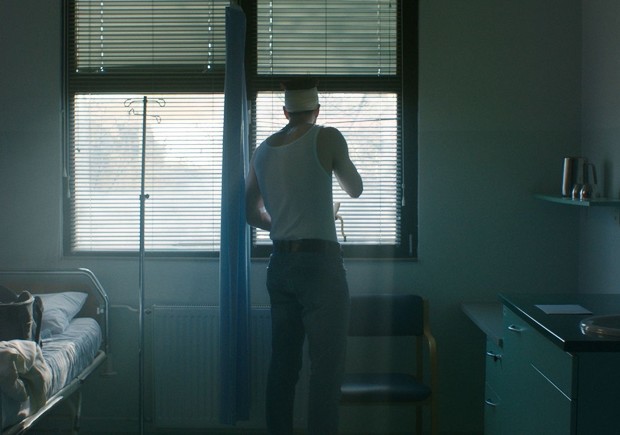
We meet our protagonist Rok (Jure Henigman) in the hospital from which he’s about to be released. He wound up there due to some kind of accident, which resulted in head trauma and severe selective memory loss. He doesn’t even remember his girlfriend Rina (Živa Selan) or their life together in the touristic town of Bled, so he insists that she leave him at his mother’s house in the neighbouring industrial town of Jesenice.

His mother (Nataša Barbara Grančer), who is recovering from cancer, is far from happy to see her son, and we sense that her reaction is justified: Rok’s countenance is imposing, and his use of direct imperatives threatening. He comes across as someone who’s capable of aggression, if not outright violence. But his younger brother Jure (Timon Šturbej) still idolizes him, and his old gang led by Damjan (Jurij Drevenšek) are more than happy to see him back.

It's this gang who teach Rok a thing or two about his dark past, namely that the gang targeted the Bosnian Muslims who still lived in the town once known for its steel mill, and that he was the main “heavy” who was quick to get his hands dirty. Re-acquainted with these facts, Rok tries to make amends with the people he wronged in the past, such as his mother and his former school friends Selim (Blaž Setnikar), Đenana (Tamara Avguštin) and Amir (Benjamin Krnetić), who now lead the town’s Bosnian Cultural Centre, and he also tries to remove his brother from his friends’ toxic influence. But can people really trust that he has changed and that this is how he genuinely feels, if he can’t even remember his own girlfriend?

Wake Me might seem a somewhat lighter riff on American History X, but relations between Slovenians and immigrants from other parts of former Yugoslavia is actually a hugely popular theme in Slovenian cinema and public discourse. Co-written by Šantić and Sara Hribar, but first and foremost by Goran Vojnović who has explored this subject through various mediums (as a filmmaker, novelist, playwright and a columnist), this movie feels genuine, and the reason for this is its treatment of the main character, played by Henigman in an all-in fashion, not to mention the film’s locations and social landscapes.

The remainder of the cast play variations on their usual roles, but Šantić capitalises on this in efficient, economic fashion. Timon Šturbej is compelling as a kid brother who becomes overly impressed by his brother’s gang and their ideology, while Jurij Drevenšek is suitably creepy as a low-level ideologist and the leader of a gang of nationalist thugs. Ivan Zadro’s hand-held camerawork and the cold, bluish-grey colours he lends to the film’s exteriors add to its realism, Vladimir Gojun’s editing is smooth, and the finely balanced use of droning music, also consisting of piano and strings, and composed by Jan Vysocky, contributes to the film’s dynamism. Šantić also executes one key scene near the end of the movie with proper bravura, which is all that’s required for Wake Me to leave a good impression and perhaps rouse people from the reigning nationalist madness.


29.9.19

A Film a Week - Verdict

previously published on Asian Movie Pulse

The topic of domestic violence is usually a tricky one. Luckily, the Filipino director Raymund Ribay Gutierrez picks the right approach: the straight one for his feature debut “Verdict”. The film has just premiered at Venice, in Orizzonti competition and its universal appeal of domestic drama combined with procedural about the faulty state of the country’s bureaucracy should assure its vibrant and long festival life.

The film opens at home with Joy Santos (Max Eigenmann, quite active on the domestic film and TV scene in the recent years) and her daughter Angel (Jordhen Suan). Their evening routine is suddenly interrupted when Joy’s husband and Angel’s father Dante (Kristoffer King, also pretty prolific lately) comes back home violently drunk and angry about some miscommunication between him and Joy. As the argument gets more and more heated, he gets physically violent toward his spouse, even hitting their child who gets in between. After slashing him with a kitchen knife in an obvious act of self-defense, Joy, pretty beaten up, runs with Angel to the nearest police station.

There is no doubt that it is not the first time Joy takes a beating from her husband and it is also granted that it would not be the last, unless she does something about it. So she files the charges against her violent husband and puts him in jail, at least temporarily, while the two of them move to a safe house kind of establishment. The trial at the court of law ensues and, as it is usually the case, it is less about justice or even law per se. So the lawyer’s games of rhetorics and establishing the narrative in which the evidence and the testimonies by witnesses would or would not stand, while everything is more or less left to the judge’s frivolous interpretation.

No doubt that domestic violence is still a big thing even in the most developed parts of the world and that countries with stronger patriarchal culture face even more problems in that regard. It is usually not the matter of positive legislative that condemns any form of discrimination and abuse of (physical and let us say economic and political) power, but the one of patterns deeply rooted in culture. Most of the cases are not being reported for various reasons and even those that are processed by the police and the court are being treated as some kind of minor offenses.

Gutierrez knows it and is not shy to show it openly using the stylistic choices along the lines of cinema verite and its echoes all over the world, usually relying on long, hand-held takes done by the cinematographer Joshua Reyles and somewhat rough editing by Diego Marx Dobles. The emotional effect is maximized even before the film’s greatest trick – the smooth transition from the domestic violence drama to procedural and court thriller of sorts that also corresponds with the transition from an individual to a more universal level. The ending with a twist is also a treat that deserves to remain spoiler-free.

It is evident that Gutierrez has a good understanding with its cast and crew and that should not be an issue since he has already worked with all of them on a similarly themed short film titled “Judgement” that treats only the courtroom part of the story. In the process of converting a short to a feature film, the actors had the most work, since their characters were developed over the course of it. Both Eigenmann and King are quite compelling in their performances, without slip-ups to the territory of over-expressive melodramatic acting, although her control is visibly better than his. Luckily, they both have to interact with a number of supporting characters played by competently relatively unknown actors who serve as the perfect buffer between the two of them.

All things considered, “Verdict” is more than a film with a good cause. Its importance is multi-layered and being simply a very good film also contributes to it.


16.9.18

A Film a Week - Holiday


Dealing with some topics and tropes can be touchy nowadays. Let us say rape or any form of violence against women, if done by a male filmmaker will always have, rightfully so, a shadow of the doubt about his intentions. Are they purely noble? Inquisitive? Political? Some form of activism? How about attention grabbing? Or simply voyeuristic, maybe even sadistic and misogynistic? Luckily, the director of Holiday, a film that has a brutal rape scene at its very centre, is a woman. The debutant in feature length format, Isabella Eklöf, also co-wrote the script together with Johanne Algren. The new set of rules applies, the film can even be regarded as subversive and therefore a perfect companion piece to a French feminist rape and revenge thriller simply called Revenge, directed by Coralie Fargeat.

It might seem like a long shot, having in mind that Revenge is pretty fast and furious, yet stylishly done action flick with more than a hint of bloodshed, while Holiday is a slow-burning gangster drama constructed around a love triangle with only one murder very late in it (and that murder is purely accidental). However, there are a lot of things in common on the surface level as well as in deeper character analysis to bring the two films together.

The list of similarities starts with the leading characters, even their physical appearance (both are lean, petite blondes) and the girly-girl style (or the lack of style to speak of). When we first see Revenge’s Jenny, she seems to be a stupid girl chasing some instant fame and falling for a good-looking sleazeball that is her boyfriend. Later on we can assume that she is an archetypical female in the male world, pretending to be anything the men around her want her to be, thinking that she would profit from that kind of behaviour. Holiday’s Sascha (played unapologetically and in stunning fashion by Victoria Carmen Sonne) is also a stupid girl of sorts, a gangster’s girlfriend so materialistic that she easily gets addicted to attention, gifts and the luxurious lifestyle without having any real clue what is actually going on. Only in the end, after the crucial rape scene (and due to it), we as the viewers can ask ourselves whether she is an intelligent, calculating psychopath in development.

The case for Sascha’s stupidity is a strong one in the beginning. Having spent all her money, she tries to seduce her boyfriend’s boss, a Danish mafia kingpin residing in Turkish resort town of Bodrum, she was supposed to give message to. She fails the loyalty test and also as a seductress and even gets slapped a couple of times for trying to climb up the ladder too fast. However, when her boyfriend Michael (Lai Yde) comes and covers her with attention and gifts, everything seems fine and she fits well in the gangster “family” (which actually seems like an extended family together with girlfriends / wives and children of different ages) occupying a hillside villa overlooking the bay. Michael might call her “princess”, but there is something cold and threatening about him, so Sascha starts hanging around a friendly-looking and kind-hearted Dutch man named Thomas (Thijs Römer) she has accidentally met at the ice cream shop. But her luck is about to change…

The good thing Eklöf does is leaving most of the circumstances clouded by mystery. It was a gamble, but it paid of. What are they doing in Bodrum except for enjoying the sea and the sun? It is some kind of business, but we do not get to know the details. We do not need them anyway. Also, the moment Michael gets bored with Sascha and turns abusive to her is hard to pinpoint, as well as his motive for such behavior. Did his boss tell him of his encounter with her? Did he find out about her relationship with Thomas and get jealous? Did he get angry about something work-related (there is a scene of roughing-up an associate that messed something up, also unexplained)? Did he just get bored for no reason? Was he planning the whole act all along as a psychopath would do?

Eklöf got lucky or, more probably, played it really clever and cool with another bluff: the structure of the film. The whole first half serves as the exposition filled with low-intensity events and glimpses into the group dynamics. So all the chips came down to the disturbing prolonged rape scene spiced up by forced oral sex, staged and filmed in one frame with such confidence that no veteran director would be ashamed of. And it worked perfectly, adding layers to characters, especially Sascha and shifting motivation, while keeping the deliberately moderate pace, making Holiday completely fresh in the terms gangster films done from a distinctively female point of view, more interested in psychology than in action.