Showing posts with label colonialism. Show all posts

9.11.25

A Film a Week - Elephants & Squirrels

 previously published on Cineuropa


Between 1883 and 1913, Swiss cousins and nature explorers Paul and Fritz Sarasin travelled to and through the country then known as Ceylon and now as Sri Lanka to conduct their research into the area’s natural history. On their travels, they amassed a huge collection of artefacts varying from tools and sacred artworks to human and animal remains, and brought it to Switzerland where it was scattered between various museums. Up until recently, the collection was the subject of a dispute between the two countries.

In his debut feature-length documentary, the Swiss artist with a background in theatre, commercials and music videos Gregor Brändli follows the Sri Lankan artist Deneth Piumakshi Veda Arachchige and her efforts to make the restitution of these stolen goods happen. Named after two of the more bizarre items in the Sarasins’ collection – a taxidermy piece with two giant squirrels and an elephant foetus taken from the belly of its murdered mother – Elephants & Squirrels premiered in DOK Leipzig’s International Documentary Competition where it won the Silver Dove for Best Feature Film by an Emerging Filmmaker. Its next stop is the IDFA’s Best of Fests section.

In the documentary, Deneth re-traces and repeats the Sarasins’ travels, which also take in her tribe and her hometown where she interviews the activists in question: the chieftain, the radio show host, the widow and the son of the local museum custodian, who are pushing for the restitution of the stolen goods. In Switzerland, she encounters the museum curators and politicians who aren’t against the restitution itself but who find excuses as to why it hasn’t yet happened. Through her exhibitions and participation in panels on (post-)colonial topics, she asks the question of who the bodies, the sacred objects and the art belong to, as well as highlighting the patronising attitudes and racism of the past which also resonate in the present.

Deneth and Brändli’s collaboration is smooth because it unfolds on honest grounds of common understanding. Jonas Jäggy’s cinematography is spiced up by footage from various sources, deftly incorporated into the material by the filmmaker himself. Blending upbeat piano notes with tenser wind instruments, Yanik Soland’s music sets the mood and the dynamic of the audience’s expected emotional response.

The film’s runtime of close to two hours might sound a tad excessive, but the situation presented in the documentary is complex and presented from various angles, with equal respect for each and a clear intention to understand. This can be observed in the lack of contrast between the expected warmth in colour and tone between the sets in Sri Lanka and those filmed in Swiss museums, which would look cold and full of bureaucratic distance in any other film. But Elephants & Squirrels isn’t a piece of agenda cinema powered by righteous anti-colonial anger. Instead, it might serve as a guide as to how disputes and toxic misconceptions of the past could be resolved in the present day.


9.11.24

A Film a Week - Sisam / Sisamu

 previously published on Asian Movie Pulse


It is a piece of public knowledge that the Japanese master filmmaker Akira Kurosawa inspired the Hollywood filmmakers from John Sturges (“The Magnificent Seven”, 1960, was basically a re-contextualized remake of “Seven Samurai”) to George Lucas whose original “Star Wars” (1977) was “The Hidden Fortress” (1957) in space. Just as well, Kurosawa himself was inspired by the literature coming from the West, from Shakespeare to the Russian classics, and s lot of his work is based on their writings.

Once again, the western world comes back as an inspiration for a Japanese filmmaker, but this time in the form of Kevin Costner’s “Dances with Wolves” (1990) which got a Japanese “reading” from the scriptwriter Masaya Ozaki and the director Hiroyuki Nakao with “Sisam”. After the national premiere in mid-September, the film was selected for Hawaii International Film Festival where it has the international premiere.

Hokaido, Edo period. Matsumae clan prospers from the trade with the indigenous Ainu people. Kojiro (Kanichiro Sato) is the younger son of the late clan retainer and he is getting ready to assume his first samurai duty at the trading post where his older brother Einosuke (Takahiro Miura) already serves. The post is supposedly peaceful, although Kojiro senses that their business is not exactly a fair trade. One night, Einosuke catches the clan servant Zensuke (Masato Wada) in the warehouse acting like a spy or a thief and gets mortally wounded in the altercation. Kojiro swears to avenge his brother and promptly gets to the action, tracks Zensuke down, but also gets wounded in combat with him.

He is found by the Ainu locals and gets nursed back to health in the house of the village chieftain. Kojiro learns the new language, culture and the way of life, while also finding out the scope of the Yamato colonization of the Ainu lands, the danger the new gold-mining trade poses to the salmon-bearing rivers and his own clan’s dirty role in it. The day of reckoning is approaching and our hero has to choose between the samurai code and the loyalty to the people who saved his life…

The title “Sisam” comes from the Ainu-language term for the neighbour, which also defines the principal topic of the film, whether the tolerance between the peoples is possible in the colonial and exploitative framework. Although it verbally takes the strong anti-colonial stance, Nakao’s film is more easily translatable to the American 90s westerns with its “benevolent exoticism” towards the natives, while never drifting too far away from the hero and its journey of moral dilemma towards the goal of realization.

On the other hand, the director Nakao matches the components of a “small movie” (such as pretty basic locations, Miki Ogawa’s largely hand-held camerawork and natural lighting) with a sense of spectacle. For the latter, the kudos go to the production designer Kei Itsutsuji, the costume designer Tsuyoshi Takahashi and especially to the composers Nobuko Toda and Kazuma Jinnouchi whose fully orchestral score brings the sense of an epic.

Acting-wise, there is a bit of phoniness here, which is expected from such historical spectacles with a broad take. However, to the actors’ defence, it is not their fault, since the script is not exactly rich in the terms of the depth of the characters, with only a couple noble exceptions like Zensuke and the Ainu widow Rikianno, but their motivational complexity is introduced mainly to serve the plot and its twists. Kanichiro Sato certainly has the star power to carry the load of the troubled hero-in-the-making, but he also tends to act in broad strokes which sometimes results in over-expressiveness.

In the end, “Sisam” is a solid, competently made piece of filmmaking, but not exactly a masterpiece. However, the merits it will be judged by the audiences lie somewhere else, in its setting and its topic, so it could serve as a conversation-starter about Japan’s imperial and colonial past.


12.8.23

A Film a Week - Sweet Dreams

 previously published on Asian Movie Pulse


As Leo Tolstoy wrote, all happy families are alike, while each unhappy family is unhappy in its own way. The rich cry, too and there is something universal about the rivalries between the loved and the unloved wives, sons and heirs, regardless of their social status. So, why would the family of the sugar plantation owners in the Dutch East Indies in Ena Sendijarević’s sophomore feature Sweet Dreams be any different? The film has just world-premiered at Locarno, where we also caught it.

Somewhere in Indonesia in the early 1900s, Jan (Hans Dagelet) owns the plantation and the sugar processing plant and rules it with the iron fist. He is no softer even at home, where he commands over his seemingly blasée European wife Agathe (Renée Soutendijk) and his Indonesian housekeeper-lover-concubine Siti (Hayati Azis), while the two battle one another, each using the means at their disposal. The only person he has the soft spot for is his and Siti’s son Karel, to whom he hand-makes the toys and whom he teaches to hunt.

Jan’s death would make a tectonic shift in the household dynamics. Agathe summons her and Jan’s son Cornelis (Florian Myjer), whom they left behind in The Netherlands, with the mix of promises (that there will be enough money once the plantation and the factory is sold) and threats (that she would otherwise cancel his allowance). So he comes with his needy heavily pregnant wife Josefien (Lisa Zweerman) only to find out that Jan has left everything to “his only legitimate” son Karel. Luckily to the colonial family, Karel and Siti have no knowledge about it. While the factory workers are striking to get their wages and the plantation workers lead by the carriage driver Reza (Muhammad Khan), who is desperately in love with Siti, are planning the sabotage and the escape, the “game of thrones” in the house begin…

The Dutch filmmaker of the Bosnian origins Ena Sendijarević embraces her both sides to the fullest in Sweet Dreams. Her sense for visuals and for framing is quite Western, structured and polished, while her writing is full of the deadpan humour and unapologetic funny menace towards her characters (especially, but not exclusively does from the ranks of the colonists and landowners) and their family bickering, and therefore a dead giveaway for her Balkans roots. For the great portion of the film, up until the filmmaker feels the urge to make a strong and symbolically potent anti-colonial point, it works beautifully, so Sweet Dreams can be compared to Yorgos Lanthimos’ The Favourite whose structure of chapters it also adopts.

Sendijarević is not the only to be praised here, although it is her vision and her task to make it come true. In that regard, she gets a lot of help from her carefully selected and diversified cast. Under her guidance, the actors seize the opportunity to play the precisely written characters with a certain theatrical gusto which highlights the absurdity of the situation the characters are in. It could be argued that the characters are almost the caricatures of one trait each (for Jan, it is brutality, for Agathe – lazyness, for Cornelis – envy, for Josefien – the sense of entitlement, for Reza – stupidity), making Siti the only person of certain integrity and Karel the only one with a clean heart, but the same simplicity works well both for the actors to do the miniatures and the film as a whole.

The technical values are also quite good, especially in the visual department. The narrow aspect ratio (which is a sort of a trend in cinema lately) here serves the purpose in the counter-intuitive way, signalling both the lavishness and the confinement of the colonial lifestyle. It is further underlined with the strong lighting, and the contrasting colours from bright reds to dreary browns of Emo Weemhoff’s lensing and the sense of decadent beauty of Myrte Beltman’s production design.

Up until the very end of the film, Sweet Dreams plays out like one of the highlights of this year’s festival circuit. In the end, Sendijarević sort of drops the ball and submits to certain conventions and trends that rule over the mainstream art house cinema, but she nevertheless demonstrates that she has a strong and unique voice.


5.5.19

A Film a Week - Tumbbad

previously published on Asian Movie Pulse

Having in mind both India's rich mythological heritage and the state of development of the country's cinema, it is quite strange that the top-quality horror-fantasy works rarely come from the world's second most populous country. However the trend can shift quickly since "Tumbbad" is one of the best and most efficient horror films seen in years. The critical response is good, the world premiere as the opening film of the last year's edition of Venice Critics Week opened the possibilities for a long festival tour (Fantastic Fest, CPH Pix, Busan, Thessaloniki etc.) and the film was already released theatrically in India.

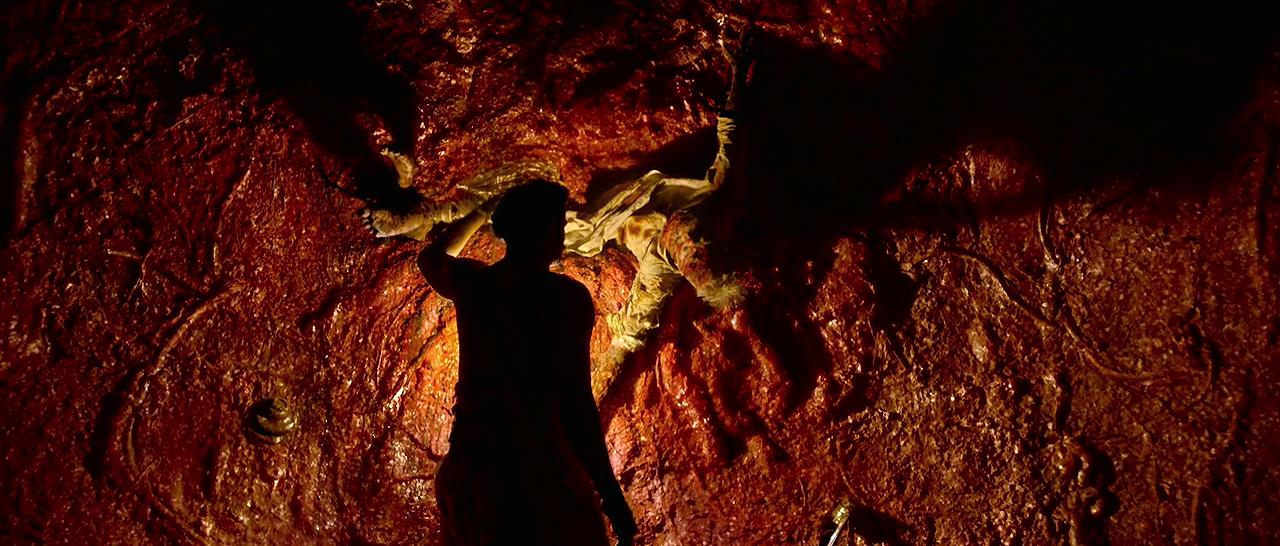
The opening quote by Mahatma Gandhi citing that the world is enough for people's needs, but not for their greed sets the topic rarely and usually superficially explored in genre cinema. It is followed by an obscure piece of mythology about Hastar, the firstborn son of the Goddess Earth, who was offered a choice between all the gold and all the food in the world. He opted for gold, but when he tried also to acquire the food, his siblings united against him. He was saved by his mother, but erased from canonical books, sentenced to spend the eternity locked in her womb (aka the Earth's core) and not to be worshipped by people. That is the point where the mythology stops and the film fantasy ensues in the form of the triptych set in the titular village in the first half of the last century dealing with the myth, human greed and the (post-)colonial context.

First we meet the widow (Jyoti Malshe) who serves as a maid in a broken-down mansion ruled by an ailing local lord. As it usually goes, the mansion has its secrets and those in case here revolve around the family treasure which has a curse attached to it. At home she has to take care of her two pre-teen sons and also for the boss' hibernating grandmother who has to be fed in her sleep because she could wake up as a demon of sorts. However, the widow's elder son Vinayak (played by Dhundiraj Prabhakar Yogalekar at this stage) shows the signs of greed and obsession with the family treasure, which could lead him in trouble.

Fifteen years later, Vinayak (Sohum Shah) is a newly-married young man living in the city of Pune who has not left his obsession behind and who takes regular trips to the mansion he inherited, always coming back with ancient gold coins, which draws the attention of his shady business partner Raghav (Deepak Damle) and the British colonial authorities. Another fourteen years on, the life of greed, opium and parties takes its toll on Vinayak and the recently established free Indian government is about to take over his mansion and Vinayak is training his young son to continue his work. The teenage boy, however, has a bold, dangerous idea to maximize the profit that could easily backfire.

"Tumbbad" is all-around brave and risky film that could easily end up as a typical Bollywood mishmash of fantasy and melodrama, riddled with B-movie clichés and poor visual effects, but it is not the case here. It is a full-blown horror, masterfully designed, chillingly atmospheric (over the course of the film, the pouring rain does not cease even for a moment), but also quite brutal when needed without resorting to simple solutions like jump scares.

Oddly, for a film directed by the team of three (Rahi Anil Barve, Anand Gandhi and Adesh Prasad who, together with the TV writer Mitesh Shah, also adapted the works of Narayan Dharap into the script), "Tumbbad" is highly coherent. The storytelling economy is perfect in the sense that the viewers get the necessary information at precisely measured doses at just the right moment, which makes the whole plot hypnotically involving. Also, for a triptych, there is not even a shade of omnibus feeling. And the colonial sub-text is obvious, but left in the background without a pretence to take over the whole film.

The acting is solid throughout, but Sohum Shah, who previously worked with Gandhi on "The Ship of Theseus", carries most of the weight as Vinayak, a greedy man of humble origins who desperately tries to buy his social status. He drops the ball occasionally, especially in the final third, employing the typical Bollywood overacting techniques instead. The rest of the ensemble playing the supporting characters is also decent, but their roles are usually based on their intriguing appearances and not on their acting abilities.

On the technical level, "Tumbbad" is nearly perfect, especially given the gap between modest budget and huge period-piece ambition of the filmmakers. The original score written by the video-game composer Jesper Kyd serves the film well, as is the rhythmic editing by Sanyukta Kaza. And speaking about the cinematography handled by Pankaj Kumar must be done in superlatives since "Tumbbad" is one of the best-looking genre films we have seen in years.

For all its merits, "Tumbbad" has to be seen as soon as possible. It is definitely a milestone regarding Indian genre cinema and a future classic world-wide.