Showing posts with label indian. Show all posts

9.2.20

A Film a Week - Lorni - The Flaneur

previously published on Asian Movie Pulse


For the most of the people, the first that comes to mind when the cinema of India is mentioned is Bollywood. Those with a broader cinematic knowledge will think of the Indian New Wave. But "Lorni - The Flaneur", a feature debut by Wanphrang K. Diengdoh is something that defies all the expectations: a micro-budgeted, guerilla-filmed noir set in a peculiar surroundings of the city of Shillong and its diverse cultural milieu. The film avant-premiered at home, at the 14th edition of Habitat Film Festival in New Delhi in May, before its official World Premiere in the First Features Competition at Tallinn Black Nights Film Festival.

Shem, played by Adil Hussain of "Life of Pi" and "Hotel Salvation" fame, is an unlicensed private investigator (the first term in the title is a Khasi-language word for an inquisitive person who knows what is going on in community) who spends his days idling (hence the second part of the title) at a local joint in the town of Shillong in the hilly state of Meghalaya in the North-Eastern part of India. His "half-breed" origins make him both a perfect insider and outsider in the Khasi-dominated local culture and the perfect man for the job of investigation of the disappearance of the missing cultural and mythical artefacts stolen from a local well-to-do household. Soon enough, the investigation takes the turn from reality towards the surreal realm of dreams, alcohol-infused hallucinations and the folklore myths...

The film's basis consisting of integral noir genre elements like the jaded, lonely detective who explains his moves and thought process in the voice-over narration, a strange mission, a proper femme fatale, some local informants and unlikely suspects is immersed into an out-of-ordinary setting of a culturally specific Indian city that is big enough to support a detective-type of story, but small enough to maintain the authenticity and the culture of gossiping. Apart from shooting the whole film in the guerilla fashion in just 24 days on a shoestring budget, Diengdoh's heroic work reflects in the fact that the elements of the local culture are masterfully interwoven, so the film cannot be written off as a piece of pastoral exoticism: the treatment of languages (a mix of Khasi, English and Hindi) heard in conversations, the culture, the philosophy and the visual identity of the place, captured through the lens of the cinematographer Paramesh Deka, feels organic in "Lorni - The Flaneur".

Diengdoh is a multi-disciplinary artist with the background in short and documentary filmmaking, music and performance arts, as well as a cultural activist in the #khasinewwave movement, do it does not come as a huge surprise that he did most of the technical and creative work on the film himself. "Lorni - The Flaneur" was his brainchild from the start and he developed it for ten years as a film and as a graphic novel. Apart from writing and directing it, he also served as his own editor and composed the original score and the songs seen and heard in the film himself, while also performing them with one of his bands, Nion.

Diengdoh's cast of local non-actors blends perfectly with the surroundings, adding another layer of authenticity to the story, while the only real star, Adil Hussain, serves perfectly as their leader and anchor, drawing the viewer's attention to himself. In the end, "Lorni - The Flaneur" is a completely original piece of filmmaking that innovates the noir genre and a pleasant, smooth and fun watch, which makes it compulsory for anyone who calls himself a cinephile.

7.7.19

A Film a Week - Ghost of the Golden Groves

previously published on Asian Movie Pulse
Recently we had "Tumbbad", a formally conventional, yet mesmerizing, demons-infested tale of greed, reviewed here by yours truly. Another brilliant, yet differently dressed, debut comes also from India - "Ghost of the Golden Groves", penned and helmed by a Bengali duo Aniket Dutta and Roshni Sen, hidden under the pseudonym Harun al-Rashid (after an Arabian Nights character who is always masked). These two titles are not even remotely same kind of cinematic works, but now it is possible to argue that horror scene in India is gaining momentum quickly.

"Ghost of the Golden Groves" comes from Bengal and relies a bit on its tradition regarding the art house cinema dating from the 60's and Indian New Wave, but it is not the only clue needed for the interpretation of this diptych of strange ghost stories set deep in the backwoods and in the time when civilization started to visit those virgin lands. Some of the clues are spelled out, literally, early on: we can hear names Seijun Suzuki, Kaneto Shindo and Teshigahara, which are all the names of Japanese New Wave auteurs and if we were not listening carefully, Dutta and Sen will treat us with a couple of references to their work. Also, some other influences can be read: David Lynch, Alejandro Jodorowsky, acid western, experimental cinema as well as early and fairly basic science fiction B-movies, all of that shot predominantly in crisp black and white, or, better said, shades of grey.

The title is a bit misleading, there is not just one ghost, but more of them in those two stories that are connected only through the sheer strangeness of events and the clash of modernity and ancient, almost animalistic superstition as a lifestyle. The first, shorter part of the film titled "The Polymorph" and based on Dutta's own short story, follows the survey officer from Kolkata named Promotho (and played by Joyraj Bhattacharjee, glimpsed in Ronny Sen's astonishing "Cat Sticks") who came to the titular forest to map the roads that would run through the area in the future. He is met with hostility from the locals and tricked by a demon who took the shape of a local performer, so he ends up lost in space and time.

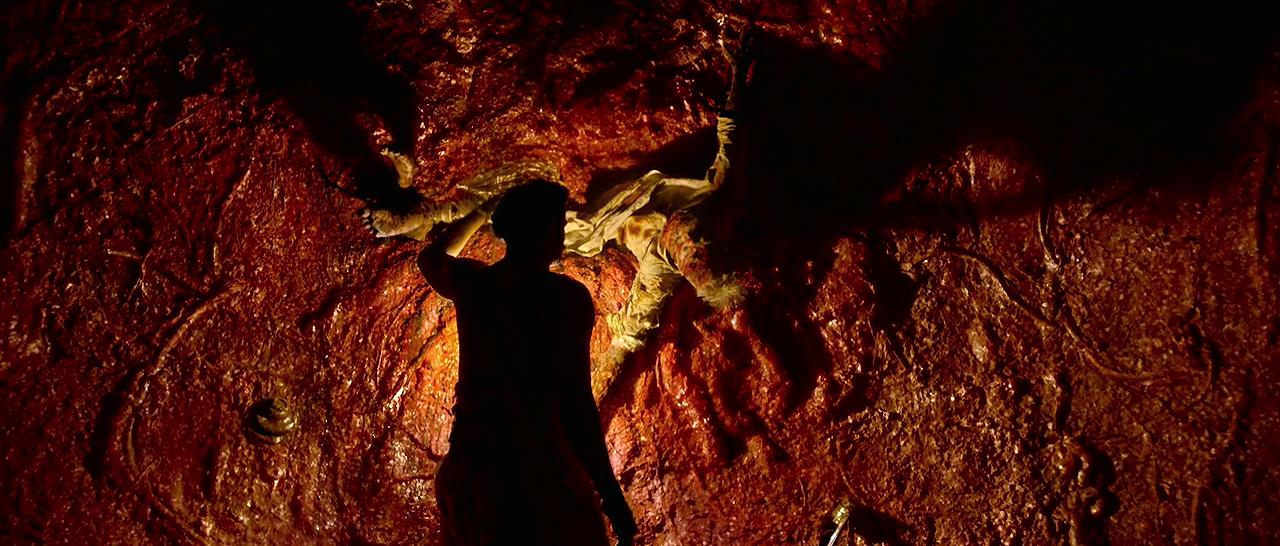
The second story, titled "Maya" and based on a short story by Bibhutibhusan Banyopadhyay, follows a poor, unemployed cook (Soumyajit Majumdar) who becomes a caretaker of a secluded, old villa owned by an eccentric old rich man (Jayanta Banerjee), despite the warnings about what happened to the previous men on his job. He does not seem to care even when a gas-masked woman, obviously from the future, starts visiting him in his dreams, followed by a group of similarly dressed people referred to simply as the others...

It would be easy, lazy and plain to write off "Ghost of the Golden Groves" for its awkwardness, because here it actually serves the purpose to tell an archetypical story about the clash between the new and the old, the civilization and wilderness. And Dutta and Sen do their best to tell it in a quite unique way, laced with humorous moments and striking visuals, effectively creating a memorable universe and using the storytelling means to the maximum effect.

Two things stand out here. One is the use of colour, first just suggested in the film's text when Promotho notices the green light in the forest only to be told by the carriage driver that people there see everything in black and white, then shown literally in cook's dreams and finally in the epilogue sequence where he recounts his story from a stage to the alien audience. That kind of use is far from the usual, it might even seem counter-intuitive a bit, but it makes sense and looks good paired with the rest of the black and white material shot by Basab Mullick that captures the attractiveness of the deep forest and primitive villages, complete with the "decay porn" of the crumbling villa.

The second one is sound design that is being used as a storytelling tool in a fresh way. Paired with an eclectic choice of music (done by Dutta), that includes rock, folk, jazz, blues, as well as electronic and modern pop, it creates a lasting impression, making "Ghost of the Golden Groves" one of the most pleasant surprises and arresting first-time filmmaking efforts in the terms of the strength and clarity of auteur vision.

5.5.19

A Film a Week - Tumbbad

previously published on Asian Movie Pulse

Having in mind both India's rich mythological heritage and the state of development of the country's cinema, it is quite strange that the top-quality horror-fantasy works rarely come from the world's second most populous country. However the trend can shift quickly since "Tumbbad" is one of the best and most efficient horror films seen in years. The critical response is good, the world premiere as the opening film of the last year's edition of Venice Critics Week opened the possibilities for a long festival tour (Fantastic Fest, CPH Pix, Busan, Thessaloniki etc.) and the film was already released theatrically in India.

The opening quote by Mahatma Gandhi citing that the world is enough for people's needs, but not for their greed sets the topic rarely and usually superficially explored in genre cinema. It is followed by an obscure piece of mythology about Hastar, the firstborn son of the Goddess Earth, who was offered a choice between all the gold and all the food in the world. He opted for gold, but when he tried also to acquire the food, his siblings united against him. He was saved by his mother, but erased from canonical books, sentenced to spend the eternity locked in her womb (aka the Earth's core) and not to be worshipped by people. That is the point where the mythology stops and the film fantasy ensues in the form of the triptych set in the titular village in the first half of the last century dealing with the myth, human greed and the (post-)colonial context.

First we meet the widow (Jyoti Malshe) who serves as a maid in a broken-down mansion ruled by an ailing local lord. As it usually goes, the mansion has its secrets and those in case here revolve around the family treasure which has a curse attached to it. At home she has to take care of her two pre-teen sons and also for the boss' hibernating grandmother who has to be fed in her sleep because she could wake up as a demon of sorts. However, the widow's elder son Vinayak (played by Dhundiraj Prabhakar Yogalekar at this stage) shows the signs of greed and obsession with the family treasure, which could lead him in trouble.

Fifteen years later, Vinayak (Sohum Shah) is a newly-married young man living in the city of Pune who has not left his obsession behind and who takes regular trips to the mansion he inherited, always coming back with ancient gold coins, which draws the attention of his shady business partner Raghav (Deepak Damle) and the British colonial authorities. Another fourteen years on, the life of greed, opium and parties takes its toll on Vinayak and the recently established free Indian government is about to take over his mansion and Vinayak is training his young son to continue his work. The teenage boy, however, has a bold, dangerous idea to maximize the profit that could easily backfire.

"Tumbbad" is all-around brave and risky film that could easily end up as a typical Bollywood mishmash of fantasy and melodrama, riddled with B-movie clichés and poor visual effects, but it is not the case here. It is a full-blown horror, masterfully designed, chillingly atmospheric (over the course of the film, the pouring rain does not cease even for a moment), but also quite brutal when needed without resorting to simple solutions like jump scares.

Oddly, for a film directed by the team of three (Rahi Anil Barve, Anand Gandhi and Adesh Prasad who, together with the TV writer Mitesh Shah, also adapted the works of Narayan Dharap into the script), "Tumbbad" is highly coherent. The storytelling economy is perfect in the sense that the viewers get the necessary information at precisely measured doses at just the right moment, which makes the whole plot hypnotically involving. Also, for a triptych, there is not even a shade of omnibus feeling. And the colonial sub-text is obvious, but left in the background without a pretence to take over the whole film.

The acting is solid throughout, but Sohum Shah, who previously worked with Gandhi on "The Ship of Theseus", carries most of the weight as Vinayak, a greedy man of humble origins who desperately tries to buy his social status. He drops the ball occasionally, especially in the final third, employing the typical Bollywood overacting techniques instead. The rest of the ensemble playing the supporting characters is also decent, but their roles are usually based on their intriguing appearances and not on their acting abilities.

On the technical level, "Tumbbad" is nearly perfect, especially given the gap between modest budget and huge period-piece ambition of the filmmakers. The original score written by the video-game composer Jesper Kyd serves the film well, as is the rhythmic editing by Sanyukta Kaza. And speaking about the cinematography handled by Pankaj Kumar must be done in superlatives since "Tumbbad" is one of the best-looking genre films we have seen in years.

For all its merits, "Tumbbad" has to be seen as soon as possible. It is definitely a milestone regarding Indian genre cinema and a future classic world-wide.

10.2.19

A Film a Week - Cat Sticks

previously published on Asian Movie Pulse
The screen debut “Cat Sticks” by the Indian filmmaker Ronny Sen challenges our prejudice about Indian cinema right from the start – it is a lean art house drama about junkies told as a mosaic composed of several stories connected thematically, while not necessarily narratively, happening over the course of one rainy night in Kolkata. The film premiered as the only Indian feature at Slamdance in its official narrative feature competition and the potential for further festival exposure is high.

Right from the start the viewer is aware that “Cat Sticks” is something else, opening with simple credits sequence of white letters on black background set against some grungy drone played on electric guitar. The stories follow several drug addicts, or groups of them, looking for the high of halogen, a special synthetic brand of heroin that created havoc in India in the 90s and the early 2Ks. This particular collection of stories can be set any time during or even after that period and its protagonists all live on the fringes of society, hustling and bustling to live to another day or looking for the pain to end (or to stop just temporarily) rather than seeking redemption. Needless to say, they chances are slim and look even slimmer hour after hour.

In Sen’s film it is less about the plot or plots and more about the context of Indian society where the lowest ranks are left to fend for themselves with little to no help from the state, family and friends. What seemed like temporary escape soon turns to be a downward spiral of addiction, pain, crime and violence. The filmmaker is not shy to show us the brutality of life like that using the striking images of extreme poverty, street life and abandoned places, but he also manages to find beauty in it, portraying it in poetic, semi-surreal fashion. Some visuals, like the plane wreck in the middle of the field used by junkies as some sort of safe house, the misfortune of a transgender prostitute who was denied the money for fix, the fight between the father and the son in a decrepit bathroom of their house, or the extended homoerotic sequence of two stripped down addicts looking for each other’s veins for fix, would leave the lasting impression.

In the terms of style, Sen is staying loyal to his fine-arts photography backgrounds, beautifully composing the frames and profiting from chiaroscuro contrasts in stark black and white captured through the lens of Sherya Dev Dube. Parallels might be drawn to the social realist traditions of Bengali cinema from the 60s, but also to American counter-culture movies of the 70s and more radical specimens of indie cinema from the early-to-mid 90s.

With a strong, yet fluid script Sen co-wrote with Soumyak Kanti DeBiswas and a cast perfectly blending both professionals and screen debutants, “Cat Skills” is an inspired and assure debut, which might qualify it for an essential viewing on this year’s festival circuit.

27.1.19

A Film a Week - The He Without Him / Runanbandha

previously published on Asian Movie Pulse

Judging by its international title, the third feature by Kolkata-based Bengali filmmaker Amartya Bhattacharyya, The He Without Him, is a poetic and spiritual meditation of sorts. All the doubts should be cleared with the explanation of the original Hindi title Runanubandha rather than its translation (as it is “credit union” which makes no sense). Used in spirituality, the term signifies “body memory”, a combination of genetic memory and empiric memory of an intimate personal contact of not necessarily sexual nature. For instance, it is also a bond between a parent and a child. The film premiered on its home turf, at last year’s edition of Kolkata International Film Festival in the official international competition.

Plot-wise, it is a story about a daughter Shatarupa Biswas (Priyanka Ghosh Roy) looking for her long-lost father, the poet Michael Hemanta Biswas on the streets of the megapolis of Kolkata, finding his voice in the voice of film director (both characters are voiced by the filmmaker himself), which leads to a conflict between trust and doubt, attraction and rejection, underlined by another actress (Urbi Sengupta) playing the imaginary version of the same character. On the symbolic level, it is also connected with the Brahman mythology and the story of Lord Brahma, the universal father and creator, being attracted to his own daughter named Shatarupa (or Saraswati, according to other sources).

Bhattacharyya is not only an indie filmmaker covering most of the jobs in the film crew, but also a painter, a poet, a writer, a photographer and, as stated in his biography, a recitation artist. His themes gravitate around the dark corners of human soul and his imagery is usually surreal and all of that could be seen in The He Without Him which was filmed on a shoestring budget, with non-professional cast (including even the film’s producer Swastik Choudhury), with Bhattacharyya doing most of the work himself, from location scouting, props and costume design all the way to writing, directing, voice-acting, editing and handling the cinematography.

Sometimes full control results in a somewhat hermetic piece of cinema and that is certainly the case here. More to the point, Bhattacharyya himself gets kinda lost in handling all the things all the time, and falls for the easy solution of being frequently repetitive in the terms of narrative and also the style with, for instance, smooth transitions from full, vivid colour to black and white and back. The lasting impression would be that The He Without Him would be more effective in a more compact format, as a 20-30 minute short, which is also the format that suits Bhattacharyya best, since he holds a pack of awards for his fiction and poetic documentary short works.

2.4.17

A Film a Week - Land of the Gods / Dev Bhoomi

Note: The review was previously published on Cineuropa
Land of the Gods, the latest film by veteran Serbian filmmaker Goran Paskaljević, is the first of its kind in at least two ways. It is the first Serbian film to be filmed in India, with Indian actors and a Serbian crew, and is also the first Serbian film to be picked up by Amazon for global VoD distribution. The film, which world-premiered in the Toronto International Film Festival’s Masters section, will benefit from some more festival exposure, but very limited theatrical distribution ahead of its VoD premiere at the end of April.

Paskaljević, who penned the script together with the film’s star Victor Banerjee (known from A Passage to India and Bitter Moon), tells a simple, local, yet universal story about a man who comes back to his native village in the Himalayas after spending most of his life abroad, only to find out that some things never change. 

After a beautiful opening shot of a religious ceremony in the holy city of Haridwar, on the banks of the Ganges, we meet Rahul Negi (Banerjee) during a long cab ride to the place he once called home. The cab driver (Raj Zutsi, from Slumdog Millionaire) informs his passenger about the monsoon and landslides that hit the area a couple of years ago, claiming thousands of lives. Rahul, on the other hand, feels tired and has only one goal: to see his village, his family and his one-time love, Maya, for the last time before he completely loses his failing eyesight.

But he is an unwanted visitor, and his return stirs up old, deep resentments. Aside from his only old friend (Avijit Dutt, from Kama Sutra: A Tale of Love), the guru at the local temple, and the new teacher (the beautiful Geetanjali Thapa) who wants to bring some modernity to the village, everybody else sees him as a threat. As the story unfolds at a deliberate, meditative pace, we learn that he had previously challenged traditions, which resulted in him being banished from the village. The model of patriarchal rule and caste system is still alive and kicking, even though the world has changed and the village is becoming depopulated.

Building on the simple set-up with deep emotions, and adding details of the local context to it, Paskaljević has arguably made his best work since Powder Keg (1998). The camera work by his regular DoP, Milan Spasić, is stellar, catching the beautiful vistas of Uttarakhand state as a contrast with the hardships of daily life in the mountains. The sense of realism is underlined by relying only on local, traditional costumes and music. The only thing not local, but still quintessentially Indian, is the great poet and Nobel Prize laureate Rabindranath Tagore, to whom Paskaljević refers twice in the film, as well as concluding it with a title card of one of his quotes.


Paskaljević has worked on fairly unorthodox productions before, filming abroad and always blending into the culture of the country where he filmed and the milieu of his characters, as in Someone Else’s America (1995), or in the Irish-set How Harry Became a Tree (2001), while his Honeymooners (2009) was the first ever Serbian-Albanian co-production. With Land of the Gods, Paskaljević has taken this to another level. Filmed within the tight timeframe of only five weeks in difficult terrain and on a tight budget, Land of the Gods is a great Indian film with universal appeal.