Showing posts with label german cinema. Show all posts

14.12.25

A Film a Week - Interior

 previously published on Cineuropa


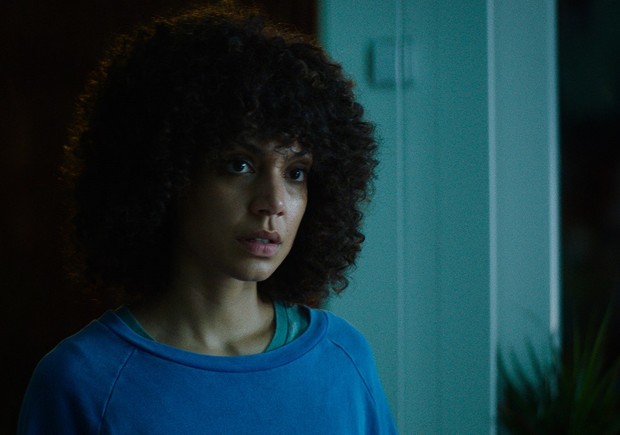
When someone breaks in somewhere, the motive behind it is usually to take something valuable from that place. Rarely do the burglars leave something behind, and if that is the case, it’s usually some kind of surveillance equipment that gets installed somewhere. Is it somehow more ethical if someone does this for the purposes of scientific research? Where exactly do the boundaries of other people’s privacy lie, and what goes on in our homes when we’re not there? These are the initial questions underpinning Pascal Schuh’s graduation work and feature-length debut, Interior, which has just premiered in Tallinn Black Nights’ First Feature Competition.

A mute burglar credited as Kasimir (Daniil Kremkin) gets smuggled into other people’s houses when they are away in order to set up surveillance systems. He then clandestinely films them in their most intimate moments and brings the tapes to the enigmatic Dr Liebermann (Knut Berger), who studies human emotions, people’s reactions to them and human behaviour in general. Kasimir also lives with the doctor, in the garage in his home, and always prepares the same dinner for both of them day after day. Sometimes, they have karaoke sessions. Maybe Dr Liebermann is onto something big, and Kasimir’s role is essential for it.

The doctor’s rules for Kasimir’s actions are simple and strict: he cannot interfere, no matter what happens, because he would compromise the data by doing so. But, although there is some kind of Frankenstein dynamic between the two, Kasimir is not an emotionless monster, so when the situations he observes become more complex or get downright life-threatening, he is bound to react and interfere. On the other hand, the cold, methodical doctor starts harbouring feelings for a person he initially treated as a tool…

Think of Ari Aster’s Hereditary and Midsommar conceived in a vein shifting from the Greek Weird Wave to Harmony Korine’s nihilist cinema, and constructed around dark and bizarre anecdotes lifted directly from the crime and accidents pages of German local newspapers, and that would be one way to describe Interior. Another would be the emotional arc from the story of Frankenstein with an added hint of queer romance. However, although there are plenty of references to be found in, or read into, the movie, Interior is something new, refreshing, brave, and made with lashings of vision and skill.

Every single component is well thought out and quintessential to the film – from the unique production design by Olga Gredig, the costumes, the score by Erik Johann Fodi that keeps introducing new instruments into the mix, all the way to Greta Isabella Conte’s camerawork, which gets messier as the emotions turn more complicated, and the ever-precise editing by Frederik Franke. The centrepiece sequence of open brain surgery blended with a saxophone solo and a disturbing dream sequence is a virtuoso showcase of Schuh’s filmmaking talent and could easily stand alone as a separate short film, but it serves equally well as part of this feature.

Interior is a student film made on a shoestring budget, but it has been crafted with enthusiasm and vision, meaning that all of the right decisions have been made along the way. It could probably not have been made any other way, since it is definitely well considered, but never calculated. It is an unhinged, shocking, bold, cerebral and visceral piece of cinema that we do not get to see often enough on the festival circuit, and it must have been a herculean effort for the young crew behind it.

23.11.25

A Film a Week - Greetings from Mars / Grüsse vom Mars

 previously published on Cineuropa


Much like Marc Rothemund’s Weekend Rebels, which played last year at the Zagreb Film Festival, in the KinoKino sidebar dedicated to younger audiences, Sarah Winkenstette’s Greetings from Mars, which is being shown in that same sidebar this year, takes its core subject of autism quite seriously. It is not used as a gimmick to propel comedy or drama around the young protagonist, but it is an integral part of his personality. Judging by its festival track record so far – a prolonged tour sprinkled with a handful of awards – the approach has paid off.

Our ten-year-old hero named Tom (Theo Kretschmer) is growing up with two siblings in a single-parent household. Since their father passed away recently, the mother, Vera (Eva Löbau, recently glimpsed in The Teachers’ Lounge, has little choice but to agree to a four-week business trip to China. For Tom, his daredevil brother Elmar (Anton Noltensmeter) and their teenage sister Nina (Lilli Lacher, glimpsed in last year’s Berlinale title Ivo), it means that they will have to spend that part of the summer holidays with their paternal grandparents, Horst (Michael Wittenborn, a character actor seen in Toni Erdmann and All Quiet on the Western Front) and Hanna (Hedi Kriegeskotte, mostly active on television), who are still coming to terms with their son’s passing.

Tom is interested in space exploration, and his dream is to become an astronaut and visit Mars. He can flood anyone who’ll listen with a ton of facts off the top of his head, on this and other topics, but he has a hard time managing everyday challenges, like seeing the colour red, hearing loud noises and enduring unwanted physical contact from anyone other than his mother. Tom sees staying with his hippie-like grandparents in their house with a red front door and no rules as a training mission for his future career as a space explorer. He has even found some ideal mission-related roles for his siblings, while the mystery surrounding the disappearance of an asteroid keeps his mind occupied. As is usually the case, adventures and new challenges will ensue…

Although it is pretty clear from the get-go that Tom is different from his (neuro-)typical siblings, the diagnosis is not uttered until the third-act climactic scene. That decision shows a certain seriousness and respect for the topic that Sebastian Grusnick and Thomas Möller dealt with in their book, which Winkenstette tries to adapt for the screen. Theo Kretschmer’s lived-in, but also measured, acting helps the cause as well, while the rest of the cast have no trouble striking up their own chemistry with the young lead and with each other.

However, some of the solutions that Winkenstette opts for are quite run-of-the-mill, such as Jakob Berger’s hand-held camerawork, while the on-the-nose score by André Feldhouse gets overbearing in its attempts to constantly spell out the desired emotional tone. But the film is actually saved by Nicole Kortlüke’s editing: not just because the animated material is deftly blended with the live-action shots, but also thanks to the roughness of the montage sequences when Tom gets agitated: in this way, the movie presents what is happening in his head in a compelling fashion.

In the end, Greetings from Mars accomplishes its mission of exploring and presenting “foreign inner universes” to neurotypical audiences with great empathy and warmth. Both children and their parents could learn a thing or two from Sarah Winkenstette’s film.

16.11.25

A Film a Week - Active Vocabulary

 previously published on Cineuropa


Preparations for war do not begin on the frontlines, or even at military training facilities. No, the narrative is laid out in the media for adults, and even at school for children. It seems unethical, and it is even forbidden outright in advanced Western democratic societies (although a teacher is allowed to intervene when students start expressing extremist or totalitarian worldviews), but it is a common practice in societies with lower democratic standards. Sometimes, the indoctrination is subtler, but in the case of Russia, it is completely obvious and very extreme. We were able to see it in this year’s hit documentary Mr. Nobody Against Putin, co-directed by David Borenstein and Pavel Talankin. The latter is a former teacher but also the film’s primary subject, narrator and cinematographer, who shared his experiences of the soul-crushing system of propaganda and recruitment of young people for cannon fodder.

The winner of DOK Leipzig’s German Documentary Competition, Yulia Lokshina’s Active Vocabulary, deals with the similar experiences of another teacher from Russia who had to leave her country, her position and her family behind in order to seek political asylum abroad. Back in 2022, Maria “Masha” Kalinitschewa was recorded by a student in her small English-language class of four when she shared her thoughts on the war in Ukraine, labelling it unjust and potentially disastrous both for Ukraine and for Russia. The candid mobile-phone recording reached the students’ parents, but also Masha’s colleagues and superiors. Threats were made against her, and she and her mother were even investigated by the FSB for scrawling anti-war graffiti on a wall in their village in the Russian Far East. Masha managed to escape to Germany, where she, with her new class of Berlin kids, wants to make a re-enactment of the incident that forced her to leave her home country.

But this is just one of the plot lines in Lokshina’s self-produced, micro-budget documentary essay laced with a few experimental touches. The Russian-born, German-based filmmaker also narrates her own experiences with the Russian school system and migration to another country at primary-school age, a specific ban that effectively outlawed political indoctrination in West German schools in the 1970s and is still in effect post-reunification, and a seemingly unrelated 2021 incident in which a group of female activists tried to stop a New Moscow construction project in a wooded area close to the Russian capital.

It seems that the topics Lokshina deals with have little in common with each other, apart from creating a consensus that today’s Russia is a totalitarian place where the orders from above show little concern for the ideals of justice, common sense, ecology, and individual and collective well-being. However, the essayist approach allows for these kinds of analogies, loose metaphors and abrupt jumps between topics. The use of JS Bach’s suites as the musical background is effective, as is the simple, hand-held camerawork by Nina Wesemann, while the satellite still photos and archival footage previously obtained by Lokshina herself are deftly edited into the material by the filmmaker and Maya Klar. The standout aspect is, however, the 3D animation by Felix Klee that exposes Russian delusions of grandeur with a model of the “monster school” that is being built in New Moscow, lending it an X-ray-like quality. In the end, Active Vocabulary emerges as an on-point, engaging and thought-provoking documentary.


23.8.25

A Film a Week - Donkey Days

 previously published on Cineuropa


Family dynamics are always tricky to negotiate, so it should come as no surprise that the relations between family members are often at the centre of the literary and cinematic works. This is certainly the case with Donkey Days, the sophomore feature written and directed by Rosanne Pel, so far best known for her Toronto-premiered debut, Light as Feathers (2018), in which she examined how an abusive relationship between a teenager and his mother can spill over to the outside world. Donkey Days has premiered in the main competition of Locarno.

This time, we have two adult sisters, Anna (Jil Krammer, in her first screen role) and Charlotte (German actress Susanne Wolff, recently glimpsed in Köln ’75), who have always fought for their mother’s attention. The mum, Ines (veteran actress Hildegard Schmahl), is quite a piece of work herself. At first, one might think that she is trying to balance out the dynamics between her daughters, but she actually fuels their rivalry. The question is whether she does so willingly, for the sake of manipulation, or unwittingly, simply by making questionable choices.

The sisters have adopted different coping mechanisms to deal with the mother. While schoolteacher Anna reacts impulsively, through sulking and childish tantrums, Charlotte tries to present herself as a highly organised person. Their tactics, however, take different tolls on their lives, since Anna manages to sabotage the relationship with her partner Noe (Amke Wegner), and Charlotte always comes across as cold and distant. Ines’s advancing age and her secrets, which Anna and Charlotte come to discover, such as a “mystery urn” and her love of donkeys, present new challenges for them and their already troubled relationship.

The structure of the movie, in which the first two-thirds of the running time can be seen as a prolonged exposition, does not make watching Donkey Days a very pleasant experience. However, it places the viewers directly into the minds of the sisters, particularly Anna, and makes them feel the emotional turmoil the two have to grapple with when dealing with their mother. Viewers may also get a bit lost and confused owing to the fact that, at least during the exposition part, the plot might (or might not) be presented chronologically, while the filmmaker also introduces a kind of “alternative reality” where the sisters meet their mother as a young person of about their age. The sense of unnerving disorientation is further underlined by the use of unsteady, handheld camerawork with numerous horizontal pans by cinematographer Aafke Beernink as well as by Xander Nijsten’s seemingly rough editing, while the atonal music score by Ella van der Woude also plays a part.

The actresses and their work are among the chief saving graces of the movie. Hildegard Schmahl has a strong, commanding screen presence, while the chemistry between Susanne Wolff and Jil Krammer is palpable. The latter is also paired well with another non-professional, Amke Wegner, and thanks to Rosanne Pel’s work with them, their lack of formal experience never shows. As a bonus, Carla Juri shines in a few flashbacks as the young Ines.

In the end, Donkey Days is less about the story and making some kind of point than it is about the vibe. This kind of approach could be classed as risky, but it is obvious that this time, it is a deliberate choice, and it consequently bears a strong auteur-driven hallmark.


11.5.25

A Film a Week - Slackers / Nulpen

 previously published on Cineuropa


While the original German title (Nulpen, meaning “idiots”) might be too harsh on the film’s protagonists, the international English one seems quite appropriate. It is summertime, school is out, and teenagers Ramona (a newcomer Bella Lochmann) and Nicola (slightly more experienced Pola Geiger) have nothing better to do than mischief hoping to provoke reaction from their environment. Their acting on impulses has a bit of destructive aura to it, and after one such incident, they take Ramona’s younger brother Noah (the adorable Rio Kirchner) in tow in order to, at least half-heartedly, try to repair the damage they caused. That sets them on a string of adventures where people, animals and objects get misplaced, lost and found.

Yes, they are proper slackers: or are they just two lost girls compared to whom the little Noah seems more mature in reasoning. Their devil-may-care attitude verging on arrogance is a facade that theoretically protects them from the world. But the two friends come from very different environments, which causes cracks in their seemingly firm friendship. Can it stand the test of time, not just the future that could steer them in different directions, but also the present? Maybe just for a day marked with climate protests, strange encounters and not always the wisest decisions?

Gajewski tries to capture the vibe of the real-life city, away from the landmarks and internationally recognised “cool” places. There is a bit of looseness of Richard Linklater’s Slacker in the DNA of Slackers, and there is a lot of a ballsy attitude in which the filmmaker, not unlike her characters, tries to mask certain insecurities. There are moments of gentleness as well, even as they serve as a brief recess from the characters’ attempts to get out of the trouble they usually brought upon themselves. The two young lead actresses embrace their characters and interact with each other and with the outer world with some palpable chemistry.

There are missteps, too. The hand-held camerawork by Hannes Schultze sometimes gets close to chaotic shakiness for no good reason, while the infusion of music of different genres draws Slackers close to the category of hipster cinema. Although the editor Rafaéllo Lupperger does his best to tighten things up, and largely succeeds, Slackers seems like an oversized short film or a string of those.

Let us make no mistake, it is a student film and it shows. But Slackers also demonstrates Gajewski’s bravery to make mistakes while searching for her voice.

24.11.24

A Film a Week - Weekend Rebels / Wochenendrebellen

 previously published on Cineuropa


According to the statistics printed on a textual info-card during the ending of Marc Rothemund’s Weekend Rebels, one in every 100 children is autistic. Since autism is a spectrum, the manifestation of it and the needs of autistic people are diverse, so they very much depend on the response from their immediate environment – especially its understanding, acceptance and support.

Rothemund’s film is based on the true story of Mirco and Jason von Juterczenka, which was previously published as a blog and a book by Mirco himself. The Zagreb Film Festival has screened it in the Kino Kino competition, which showcases children’s flicks.

Jason was born with Asperger’s, which prevents him from functioning as neurotypical kids do. As the specialist informs his parents, Mirco (Florian David Fitz) and Fatime (Aylin Tezel), he can develop special interests and thrive by pursuing knowledge about them, but he needs a strict set of rules to abide by as well as their constant love and support. Jason (newcomer Cecilio Andersen) grows up to be a smart, curious boy interested in space, advanced physics and the preservation of the environment, but is also attached to some of his routines and rituals that make little sense to others.

At school, he is not accepted by his peers, and he sometimes reacts to their provocations with violence. One thing he gets from them, however, is the notion that he needs to pick a football club to support. Since his parents support different teams, he forges a system to test all of the German professional clubs against his set of rules so as to find the one he should support. Mirco volunteers to take him to games across Germany, which comes as a relief to Fatime, who is exhausted from caring for Jason and his needs.

Insights from Grandpa (Joachim Król) and from other football fans might come in handy, but Jason has to learn how to put up with a world that irritates him with loud noises, vivid colours, involuntary touches and situations that bring his rules into conflict with one another. Can Jason learn how to stand this outside world that he cannot control in order to fulfil his goal?

Weekend Rebels is clearly a film with a positive message of patience, tolerance and understanding to convey, which it does through the simple, but efficient, script by Richard Kropf. Marc Rothemund, best known for his acclaimed 2005 Berlinale title Sophie Scholl: The Final Days [+], directs it in a fitting, not overly obtrusive, way that is still dynamic enough to hold the attention of the target audiences – kids and their parents – even in the slightly repetitive scenes and sequences. The dynamic camerawork by Philip Peschlow in bright and vivid colours certainly helps, and so do the striking sound design by Lena Beck and the rapid editing by Hans Horn and Chris Mühlbauer. The omnipresent, gentle music by Johnny Klimek and Hans Hafner is, on the other hand, a bit too on the nose in its attempts to dictate the viewer’s feelings.

The acting is also solid throughout. Cecilio Andersen is bubbly and believable in the role of Jason, while Florian David Fitz imbues Mirco’s character with the gentle energy of a father willing to go the extra mile to please his son. On the other hand, Aylin Tezel does not have that much work to do as Fatime, but veteran thesp Joachim Król steals a few scenes as the football-loving Grandpa. In the end, Weekend Rebels overflows with warmth and empathy.


29.10.23

A Film a Week - Home Sweet Home

 previously published on Cineuropa


Home films and video don’t lie. Why would they? They have been filmed without any artistic or filmmaking pretence, merely to record moments of life and happiness within the family circle. Or maybe they do lie? Because, artistic pretence or not, the amateur filmmaker or cinematographer at least selects what is and what is not to be shot on film or tape. So even if whatever we see is nothing but the truth, it certainly is not the whole truth.

German editor Annika Mayer chose to utilise Super 8 home movies for her feature-length directorial debut. Home Sweet Home has just premiered in the national documentary competition at DOK Leipzig and takes us behind the idyllic images of the happy life of a family in West Germany from the 1950s to the 1970s.

The family in the Super 8 shots, initially in black and white, then in colour, is not just any family. The parents, Rolf and Rosa, are the filmmaker’s grandparents. Their eldest son Ernst is her father, while the younger Frank is her uncle. The happiness and the idyll in the films that they enjoy during leisure time, trips to the seaside or the mountains, and their sailing adventures might seem real and very much in accordance with the spirit of the times in West Germany, which back then was experiencing an economic boom after the war-time destruction; however, there is something off with one of the faces whose smile tends to look more like a spasm. That face belongs to Grandpa Rolf.

But Grandma Rosa is the one to tell us the story from “behind the scenes” that could not be further from the harmony shown by the home movies. The story she tells is horrific, as it entails terrible domestic abuse in a society that is completely unaware of it. Firstly, Rolf is 13 years older than Rosa, coming from an affluent family, and she was pressed by her own parents to drop out of school in order not to pass up a great marriage opportunity. Secondly, he is a war veteran who served in the Wehrmacht as a gunner, from Paris to Crimea, so he probably suffered from some kind of PTSD. Finally, he was not shy about showing his temperamental issues, even to his parents. Domestic violence is rarely monocausal, so with a patriarchal framework, probable trauma and various personality issues at play, it can get really ugly. Rolf’s reactions were unpredictable, and that coupled with alcohol abuse, a propensity for cheating and unresolved love-life issues made things escalate from regular beatings to more concrete, life-threatening behaviour.

Working with a limited quantity of source material (as is evident from some of the frames repeating themselves throughout the film, especially towards the end), Mayer introduces newly filmed interviews lensed by her co-producer and regular collaborator Jakob Krese, which actually gives Rosa more space to tell her story. The contrast between what we hear and what we see is stark, but also very logical in the wider context of things. Mayer’s own editing is methodical and rhythmic, keeping this concentrated experience to a fitting 67-minute running time. The other hero of the film is the score composer and sound designer, Gaston Ibarroule. His sound design gives another dimension to the doc in a very material way, while his atonal, distorted music comments on the imagery. In the end, Home Sweet Home is anything but sweet, but it is a strong wake-up call.

24.9.23

A Film a Week - Arthur & Diana

 previously published on Cineuropa


The road is a common metaphor for life. A road trip with family members, especially with a toddler in tow, however, might turn out to be a living hell. One such lengthy road trip, from Berlin to Paris and then on to South Tyrol in Italy, is portrayed in the auto-fictional film Arthur & Diana, written, directed and edited by Sara Summa, and which recently had its world premiere in the Discovery programme of this year’s Toronto International Film Festival.

Siblings Diana (the filmmaker herself) and Arthur (her real-life brother Robin Summa) travel with the former’s two-year-old son Lupo (the filmmaker’s adorable son Lupo Piero Summa) in an old, rusty Renault Espace. Their starting point is Berlin, where they say their goodbyes to Lupo’s father Patrick (Benjamin Schwimm) who sends them off with a load of junk food. At first, their goal is Paris, where the siblings’ mother Betty (Claire Loiseau) awaits them. The reason for such a travel by car, apart from Arthur’s fear of flying which is mentioned briefly later on, might be the annual technical inspection of the vehicle (with an uncertain outcome). Of course, they stop a few times: to take a hitchhiker (Livia Antonelli), spend the night in a camp, get pulled over by a police officer, take a detour to a lake… Even a forgotten gun goes off at one point, luckily to no consequence.

However, there is something unpleasant in the air between brother and sister, starting with their disagreements on technological progress and the different ways they lead their lives. Things from the past resurface and are discussed, building up to a heated argument. Even the car itself has its story and its secrets. Eventually, all the signs point to Arthur’s and Diana’s late father. Maybe the trip to Italy to attend the funeral of a relative could clear the air, but with families and unspoken resentments between their members, one can never be sure.

Although there are of course pieces from the filmmaker’s own life all over the film, her goal here is not to expose herself and her own family secrets, but rather to capture a certain moment in time that seems both diffuse and turbulent. Sara Summa excels in all four roles she’s assumed, filling the film with authenticity and sincerity throughout. As a writer, she is more than able to convince us that she is the one looking for the answers, along with us in the audience, all the while shifting fluidly and logically between three languages to tell her story. As a director, she is not afraid to take on the difficult task of filming around a toddler, a being that is unable to stay focused for long, while maintaining control over other aspects. As an actress, she gives herself completely and creates a strong chemistry with her brother (his acting experience also helps here) and her son. Finally, as an editor, she controls the rhythm of the film, while her weaving of some purely observational documentary sequences into the fabric of the fiction film is masterful.

Visually, Summa and her cinematographer Faraz Fesharaki aim for the feel of something between a documentary from the 1990s and home video from the same period. Although it was shot on different cameras and with different formats, the idea to finally print everything on 16mm film proved fruitful, since the natural warmth of this format serves the film well. In the end, Arthur & Diana is a sincere, warm, introspective experience that showcases the multitude of Sara Summa’s talents.


24.12.22

A Film a Week - So Long Daddy, See You in Hell / Servus Papa - See You in Hell

 previously published on Cineuropa


 For various reasons, ideals and ideologies struggle to withstand reality, so they must adapt to new circumstances. Religious cults, colonies and hippie communes of the 20th century might serve as a faithful illustration of this claim. One such commune, along with its leader and a bright, rebellious teen, stands at the centre of Servus Papa – See You in Hell, which is the latest film co-written and directed by seasoned German director Christopher Roth. The film had its world premiere on home turf at the Munich Film Festival, while its first international premiere took place within Black Nights’ Official Competition in Tallinn.

It's Austria in the late ‘80s. The Cold War is coming to an end, but news from the outside world has little effect on a commune located on a river island (or is it a peninsula?) somewhere near the Hungarian border. This commune is a central part of a wider system of similar establishments located in or around various European cities, such as Frankfurt, Munich, Amsterdam and Zurich. It’s led by its chief ideologist, the self-appointed “King” and “Daddy” Otto (Clemens Schick), who employs a mixture of brainwashing, menace and manipulation. His ideology blends counter-culture with Marxism: sex is encouraged, but romantic relationships and nuclear families are forbidden as bourgeois inventions. The kids grow up and go to school together under the auspices of Otto and his predominantly female aides, while their parents are only allowed to visit them every once in a while.

Jeanne (Jana McKinnon) has lived and grown up in this commune since she was two years old. As an adolescent, however, she starts to feel more than just physical attraction for the commune’s horse handler Jean (Leo Altaras), which is against the rules and noticed by Otto, who also takes an uncomfortably perverse interest in the young woman. Jeanne is perceptive and smart enough to fend off the leader’s advances, but she might need to find a more permanent solution. On the other hand, the commune, its ideology and its way of life are the only things she knows.

Co-written by Roth and Jeanne Tremsal, the script is based on the latter’s own experience of growing up in such a commune, whose leader was eventually sentenced to 20 years in prison in 1991, for various crimes including sex offenses against minors. At the beginning of the film, Roth opts for a style which simulates an observational documentary, with shaky, hand-held camerawork by Lydia Richter, faux-VHS shots blended into the wider footage, and occasional jump cuts in the editing, which is taken in hand by the director himself. The film’s exposition is also prolonged, taking up almost half of the film’s nigh-on two-hour runtime, with Roth and Tremsal seeming more interested in exposing the commune’s functioning than in exploring the plot and characters. Meanwhile, the framing technique which sees the whole first half of the film reduced to a flashback seems a little stale.

The real plot kicks off with a change of style - calmer camerawork and cleaner cutting - but it turns out to be a little too late for developing all of the film’s important ideas on totalitarian practice and how it contradicts ideals of freedom, and the need for a revolution against the tyrannical powers that be. Luckily, the spot-on casting and eclectic musical choices, which range from pop to punk tunes, help this ambitious near-miss to go down smoother than expected.


16.1.22

A Film a Week - Precious Ivie / Ivie wie Ivie

 previously published on Cineuropa


There are two things that are widely known about racism: that it is just plain bad and wrong, and that it is far from being stamped out. While it is easy to spot it and call it out when it appears in its most blatant forms of slurs and attacks, its more candid and casual forms – which may not be derogatory per se, but which still perpetuate the stereotypes – often fly under the radar. In her first feature, Precious Ivie (coming after her shorts, one mid-length film and a few episodes of the TV show Druck), Sarah Blaßkiewitz tries to deal precisely with these forms of “positive” racism in her hometown of Leipzig.

The movie world-premiered earlier this year at the Munich Film Festival, and its screening in the First Feature Competition of the Tallinn Black Nights Film Festival serves as its international premiere. The screening here comes as no surprise, since it won the Baltic Event Works in Progress Award in the same place two years ago, while at the development stage.

It seems that none of the racism that Leipzig and Saxony are infamous for affects our title character (played by Haley Louise Jones, who has an extensive background in TV acting): she is a mixed-race young woman who feels completely integrated within German society and shares the same problems as the rest of the folks from her generation. She splits her time between two jobs, one as a nursery teacher and the other in her best friend Ingo’s (Maximilian Brauer) tanning salon, while waiting for a permanent placement at one of the posh Waldorf schools. She and Ingo, together with her flatmate Anne (Anne Haug, glimpsed in Marco Kreuzpaintner’s The Collini Case), form a trio of childhood friends.

Ivie pays little heed to the questions and comments she gets at the job interviews at schools that focus more on her racial (she is often praised for her good German-language skills, even though she was born and raised in Leipzig) than her teaching background (Maths and PE), or even to the fact that her best friends call her by the nickname “Schoko” (cleverly translated as “Brownie”). This all changes when she gets a visit from Naomi (Lorna Ishema, seen in Barbara Ott’s Kids Run), the half-sister she never knew she had, who lives in Berlin. She arrives with news of their estranged father Amadou’s death in Senegal and the idea that the two of them should go there together.

In almost two hours of running time, Blaßkiewitz squeezes in a number of potentially interesting topics, such as the contrasts of East versus West, friends versus family, and one branch of the family versus the other, but Precious Ivie is at its best when it deals with the protagonist’s carefully formed identity, which falls apart if seen from another angle and in a new light. Some of Ivie’s existential problems stem from her being black, while others are rooted in her not being black or “exotic” enough to perpetuate the stereotypes.

The trouble with Blaßkiewitz’s scriptwriting approach is that the screenplay is too free-wheeling, and Precious Ivie tends to get diluted, scattering all over the place at certain turning points. Her directing skills when it comes to working with the actors, as well as making aesthetic and technical decisions, attain a competent level, but not a memorable one, so Precious Ivie is a little bland in its style. Nevertheless, it can still be praised for the importance of its topic and the clear-eyed view it provides.

10.10.21

A Film a Week - Nö

 previously published on Cineuropa


Six years after his Crystal Globe competition title, Heil, Dietrich Brüggemann returns to Karlovy Vary with his latest film, Nö, which is having its international premiere in the festival’s main competition, following a world premiere at the Munich Film Festival a month ago. Nö also marks a creative reunion between Brüggemann and his sister Anna Brüggemann: seven years earlier, they together co-wrote Stations of the Cross, which remains Brüggemann’s biggest international success to date. Although the topic of this new film is quite different, some parallels could be drawn between the two titles.

This time, brother and sister Brüggemann examine love, marriage (or its equivalent, a long-term relationship in adulthood) and the values of today’s 30-somethings who, seen from the outside, appear to have everything they need to lead a successful, fulfilled, happy life, but are never content. Anna Brüggemann stars as Dina, who we meet in bed with her partner Michael (Alexander Khoun, who collaborated with Dietrich Brüggemann on Heil) while the two are having a lengthy conversation. Michael suggests a break-up, since the couple has different goals in life (Dina is, for instance, set on having children, and Michael is not too keen on committing himself in that way), but Dina rejects the possibility by arguing that, if there is one thing humankind can manage to do anytime, it is to have and raise children.

In the next 14 one-take scenes, we follow their relationship as it develops through phases. We get to see Dina’s pregnancy and the couple breaking the news to their parents. We see them during the different stages of parenthood, which affect their professional lives (Dina is an actress, Michael is a surgeon). We see them in a two-kids-family-unit-setting and we see them finally breaking up due to growing character differences. We never see them happy, or even content.

One-take scenes, usually from a fixed position and in a wider shot, are something of a signature style for Brüggemann, who did basically the same thing but taken to the extreme in Stations of the Cross. That formal rigidity made sense in that film, since it dealt with religious fundamentalism and poisoned family relations. Here, Brüggemann opts for a more relaxed variation: the one-take scenes are divided one from another by textual cards printed over black screen, but not all of them are static, which suggests some sense of fluidity and constant change in the dynamics between people in a relationship and within a family.

Dietrich Brüggemann shows a low-key absurdist sense of humour, using framing, shot composition and mise-en-scene to highlight the absurdities of modern daily life. Both of the lead actors show the kind of chemistry (or lack thereof) needed for their characters to be convincing in the misery of their “daily grind,” as well as perfect comic timing to highlight the absurdity of those situations, while other characters are relegated to small episodes and types. Brüggemann’s own score is played in an austere fashion and comes in handy. However, the real stars of the film are Brüggemann’s “house” cinematographer Alexander Sass (some of his shots are real masterpieces), the production designer Cosima Vellenzer and the costume designer Juliane Maier, who make this formally rigid film look lively enough for its two hours of runtime, which nevertheless feel a bit too long.

6.12.20

A Film a Week - Model Olimpia / Modell Olimpia

 previously published on Cineuropa


Can a glitch in someone’s nature be fixed by nurture in the form of therapy? In his debut feature, Model Olimpia, German director Frédéric Hambalek digs deep in order to find the answer to this question. The movie premiered in the First Feature Competition of the Tallinn Black Nights Film Festival.

Hamabalek, serving here as the writer, director, one of the producers and one of the editors, opens his film with something resembling a psychotherapy session: a young man in his twenties speaks, while a woman in her late forties or early fifties listens to him carefully, posing some additional questions. The encounter ends with her showing him some headshots of random young women, asking him to imagine details of their lives. One scene later, it is clear that this is not your average therapy session: the apartment is the same, and both of those two individuals are living in it. The “therapist” is the young man’s mother.

Something is certainly wrong with the young man (the characters remain unnamed), played by the relatively unknown Alban Mondschein, whose acting credits include several minor child appearances and TV roles. His sexual fantasies are not the healthiest, and revolve around violence and death. The mother, played by Anna Steffens, tries to take action by devising her own blend of therapy composed of orders and routines, and by imposing “healthy” models of sexual fantasies on her son. For instance, she makes him masturbate while listening to pornographic audio books, and look at erotic photos cut out of magazines and pinned to a board above his bed. She also hires a part-time prostitute and gives her precise instructions to steer her son’s fantasies so that they fit social norms.

However, they do not get any mellower or more “normal”, and he occasionally acts on them. The only presence that seems healthy in his life is his new neighbour (Mathilde Bundschuh, frequently seen in various German crime TV shows, like Krimi.de, and the various incarnations of the SOKO series), but her “liberal” lifestyle does not sit well with the mother. Could the son possibly develop some healthy romantic feelings on his own before it is too late? Could the change in the mother’s approach to therapy, which occurs roughly halfway through the film’s slender 89-minute running time, help?

Model Olimpia (the title of which works well as a reference to Alexander the Great’s reportedly domineering mother) is definitely a brave film. Hambalek, whose career up until this point has consisted of several shorts, does not shy away from the most unpleasant aspects of dark fantasies and mental illness, but still, he does not encroach even a little bit on the territory of exploitation. His primary interest is to study the dynamics within the mother-son relationship, the concept of curing something that might be incurable and the intention to help even when it can actually do more harm than good. Instead of cheap shocks, he opts for an intellectual, somewhat cold and dry form of observation from a distance, bolstered by some controlled, rock-solid acting performances. The coldness is also amplified by the colour palette in Alexander Griesser’s cinematography, while the shapes are softened, making Model Olimpia a visually polished, stylistically coherent work of cinema.


9.6.19

A Film a Week - The Captain / Der Hauptmann

The biggest mistake the popular culture did with the Nazism is failing to even try to understand it. It is not some sort of mythical evil similar to the evil portrayed in religious scripts, it is a complex phenomenon whose perversity comes from the combination of banality, primitive hatred towards the others (whoever they might be), bureaucracy, fear of authority (real or assumed), and the petty nature of a small man who often does just about anything that would secure his existence. That means that fascism can come back again in some other form if it is not recognized as such in time, and all the WWII mythomania (both of its blends, Soviet and American) would do little to help fighting it. Understanding the mechanics of the system, the general and the most specific ones), might just do the trick. As it goes for cinema, The Captain, directed by Robert Schwentke, could serve as a good example of getting things right.

Schwentke's career goes two ways. Back at home, the German-born director is interested in bizarre, but pretty much true stories, like it was the case with Family Jewels, the semi-autobiographic film about the man who becomes obsessed with the idea to steal his amputated cancerous testicle. In Hollywood, where he made the most of his films, he has earned his reputation as a reliable genre helmer with a couple of thrillers (Tattoo and Flight Plan), a spy action flick RED and the two Divergent sequels under his belt. The Captain can be certainly put in the former group: it is a stylish, artistic war movie based on strange, but true events and shot in appropriate black and white widescreen.

In the opening shot we see our title hero Willi Herold (Max Hubacher) as a simple German soldier running away from his own army's patrol. It is early spring of 1945, the landscape looks muddy, his side is clearly losing the war, but his chances to survive as a deserter, looter and hunter-gatherer are quite slim, since the sadistic bureaucratic side of the Nazi system is still intact. It is the matter of time when he would be shot. However, his luck changes after he finds a perfect Luftwaffe captain's uniform in an abandoned car. He assumes the captain's identity and invents a bogus top-secret mission for the Fuhrer himself that revolves around scanning the state of things in the rear and dealing with the deserters.

Soon enough he is joined by the band of misfits, deserters and stranded soldiers like himself and for them he poses as a figure of authority. They are all in a grave danger whenever they come across any of the regular military and military police units, but Herold authoritative pose is convincing enough and his sadistic imagination is wild enough to keep him safe, even though it means he is about to commit a horrendous crime: the mass execution at the nearby prison labour camp for the deserters, thieves and looters.

The pitch-black and sometimes uncomfortably funny tone of the film does not come just from Herold's boldness and the willingness of his ragtag companions to join him in his crimes, but also from the reactions of the regular army and legal figures. Everybody he encounters from those ranks is at first sceptical about him and his outlandish backstory, but everybody is also willing to go along with it for their own reasons: the farmers and the townsfolk will use him and his "soldiers" to deal with the looters, the prison camp command wants to scheme its way towards the goal of getting rid of the "dead weight" - the inmates, and even the opposition he meets is more or less just of the procedural type. And that basically draws a picture of the Nazi regime in all of its monstrous network of deranged grand ideas and selfish interests.

Hubacher is stellar all the way through the film. His character is complex and so is his transformation from a benign deserter to a cold blooded executor. He starts as a man we are bound to root for and than gets chilly, cold and power-crazy. He is matched well the rest of the cast, Milan Peschel as his first follower Freytag, Frederick Lau as unscrupulous killer Kipinski, Brend Hölscher as the not-very-smart lieutenant Schütte, Alexander Fehling as the prison commander Junker and Waldemar Kobus as the bureaucrat Hansen. They are all doing a good job avoiding the contraptions of the broad Nazi stereotypes, but they are not milking the sympathy from the audiences - they are still monsters, just the different kind.

The stylistic approach Schwentke goes for also suits the film well and various influences can be read from it. The director is not shy to dig deep in the dirt and mud of war in the vein of later Soviet war films like Klimov's Come and See, be bleak like New German Cinema classics like Schlöndorf's The Tin Drum and at places shocking as Pasolini's Salo. The visceral qualities of the topic itself are paired with very cerebral use of deadpan humour and a dash of spectacle.

However, not all the tricks work: the title card after the bombing of the camp could as well be the end of the film, the following shot in colour is kinda out of place and the complete extended coda is completely unnecessary. The ending credits scene in which Herold and his gang are driving in the vintage six-wheel wartime car through the city streets of a present day German town also seems a bit on the nose as a metaphor that the new fascism that is on the rise will sure have its own Willi Herold.

Regardless of some minor problems, The Captain is the film that will leave the audience with a strong impression, and make the people think about it at least for a moment. And the blend of timeliness and timelessness adds to a point made in a smart and elegant fashion.

26.11.17

A Film a Week - Making Judith!

previously published on Cineuropa

In the prologue to Making Judith!, and more specifically on a title card featuring one of his own quotes (“The only way for films to feel true is to fill them with lies”), veteran German filmmaker Klaus Lemke, dubbed “The Pope of Kitsch”, not only gives his educated opinion on low- to no-budget filmmaking, but also offers the key to the interpretation of the film and his intentions behind it. It is not about the plot itself; it is about Lemke, his persona, his ideas on contemporary filmmaking and turning the title character into his new muse. The film has just had its international premiere at the Viennale, where Lemke enjoys something of a cult following, just a few months after the world premiere at the Munich Film Festival.


Lemke is a unique figure in German-language cinema, as he is the only one of the “New Munich Group” who stayed faithful to his low-budget roots, making a number of trivial genre- and subculture-themed and trash films in dialect, rather than in standard German, with non-professional, almost randomly chosen cast and crew members. Earlier in his career, Lemke acted in his own films, but he has not done so recently, which makes Making Judith! his big acting comeback. His trademark pimp-style hats, torn jeans and Air Max Nikes are an integral part of his style and persona that he plays both on and off screen. For him, filmmaking is a chance for anyone to be someone – or something – else: he would rather be his films than himself.


But not all movies are destined to be finished, which is the lesson that Lemke has to learn the hard way when the noir-like family mystery surrounding his alleged daughter Caroline (Mela Feigenbaum), set under the blazing sun of the Canary Islands, solves itself too quickly and leads nowhere. Lemke needs his new film, and his secretary Judith (Judith Paus) is ready to do anything to secure her big role in it. However, the director will intentionally test her patience by spending the money she stole and the money they both swindled out of an investor (Murat Mermer) on his own carnal pleasures. He evidently has no idea what to make a film about, and Judith is no actress or producer. Will he make her an actress? A producer? His muse? The new Saralisa Volm from Finale, Dancing with Devils and Berlin für Helden?


One cannot say that Making Judith! is a stellar example of exceptional filmmaking, because it is not. It is deliberately bad to the bone, filmed on a seemingly home-video level of equipment, with Paulo de Silva handling both the cinematography and the sound, and lit so poorly that the actors stay in the shadows for most of their time on screen. But Making Judith! is mind-blowingly funny and takes much pride in its trashiness. It actually serves as a bold statement against gentrification in cinema. With his latest production, Lemke has remained loyal both to his style and to his persona, and hopefully, he has secured a muse for his next few projects.


8.10.17

A Film a Week - Berlin Syndrome


Every time has its own special place to name it the centre of the world. Paris and Vienna were that in the beginning of the last century, London and New York were that at the end of 20th and in the beginning of ours. Nowadays, it is Berlin, the liberal-minded work and travel and squat and party destination made from the anarchist tradition of its western part and ashes of the eastern part’s socialism. The youth going there to pass or to stay for a while does not care much about that, Berlin is just a cool place to be at one point. And like any cool big city, Berlin can also be a very lonely place, which is one of the alleys Berlin Syndrome goes.

For Claire (young Australian star Teresa Palmer), a young photographer interested in GDR architecture, Berlin is a place where she wants to find herself. However, she will find Andi (Max Riemelt), seemingly cool school teacher who seems like an ideal partner for a fling. So she agrees to spend the night in his apartment only to find herself locked inside the next morning when he goes to work. It does not take much for her to realize that she is a captive and that the way out will not be easy.

The basic idea is straight out of horror genre, but the screenwriter Shaun Grant adapting the novel by Melanie Joosten and especially the director Cate Shortland are more interested in psychological drama of it all. As the title suggests, it has something to do with Stockholm syndrome: when Claire realizes the resistance is futile, she gets used to the daily routine of living with a man with quite a peculiar idea of being romantic. Also, Andi is not your basic film psychopath, sure he is a functional one, hiding “mommy issues” behind the facade of a quiet man, but there is more to him than his routine and his quirks.

Both of the actors thrive on their well-written characters. Teresa Palmer delivers an understated, soulful, quiet performance, while Riemelt’s calmness, sincerity and naivety makes his character even more chilling. Their chemistry is evident in the scenes they share and Shortland’s sense of space, a confined one that is, adds another layer to the overall unpleasant atmosphere.


The problem with films like Berlin Syndrome is once the setting is done and the woman ends up kidnapped, there is not much room for experimenting. The not so deep psychology can hold our attention for a while and Cate Shortland is a very skilled filmmaker to take the maximum of it and her previous effort Lore is a stellar example of a trans-genre approach. Still, around midpoint, Berlin Syndrome starts to drag a bit and the whole third act requires a considerable suspension of disbelief, but in the end this Australian-German co-production from this year’s Sundance Festival is worth watching for the reason of talent on screen and behind it going from horror to drama to thriller and back.

4.6.17

A Film a Week - Morris from America


Being a thirteen year old sucks. Growing up sucks. Dealing with hormones sucks. Dealing with parents sucks. Dealing with unfulfilled sexual desires sucks. Dealing with own body sucks. It might be all be over soon, but that particular phase is especially heavy even if someone’s life is pretty stress-less. Just imagine how it would be like for a chubby black boy from America who is a recent transplant to Heidelberg, Germany where his single father is trying to make it as a football coach. Certainly, it is not very pleasant.

Morris (a newcomer Marquees Christmas) is spending his days practising his freestyle rap, writing rhymes, arguing with his father Curtis (Craig Robinson doing arguably his best work) about old and new school and learning German with his mentor Inka (Carla Juri of Wetlands). It is actually her idea for him to go to a local youth centre so he can make some new friends and get a chance to speak the language with someone his own age.

And that is where the things start to get tricky. It is not the white sheets and burning crosses KKK or police brutality kind of racism as it still exists in the USA, but being the only black kid in a pictoresque, old, but still provincial town, Morris stands out. The racism here is of the casual kind based on “common knowledge” like all the black kids should play basketball and the black kid is the first suspect when it comes to bringing weed to the centre. The guys there are not monsters, but they are, as our protagonist puts it, “dickheads”. Morris’ “gangsta” pose trying to cover the fact that he is still a confused kid and probably a big softie does not help either.

But the real trouble, as always, comes in the shape of a girl. A slightly older Katrin (a seductive Lina Keller) starts to hang out with him. Maybe that is her way to show her rebelious attitude to her environment. Maybe she takes a general interest in a shy, foreign kid. Maybe she just likes to play with younger boys until she rides in the sunset on the back of her DJ boyfriend’s motorcycle. Anyhow, her hot and cold games are rocking the kid’s world.

The writer-director Chad Hartigan, born in Cyprus, knows a thing of two about being a foreigner trying not to lose identity while fitting in another culture and how it is difficult for a kid to find a right balance. The tone he holds on to is bittersweet, not playing for the cheap laughs, not too serious and not too romantic, since all of Morris’ troubles will pass one day soon The director knows it, we know it and Curtis knows it (shown in Robinson’s “big scene”, a monologue about how love made him cross the ocean and land in a foreign country), but the kid still has to learn it the hard way.


Lively paced, well-acted and dipped in the sunny colours of the European summer, Morris form America is a very nice example how coming-to-age films should be done. Hartigan uses the tropes of the sub-genre to his aid and builds an earnest vision upon them. Growing up is a real mess, but we will remember our troubles for life. And as the time passes by, our memories will be sweeter and sweeter.

23.7.16

The Weather Inside / Das Wetter in geschlossen Räumen

note: This is an English translation of a previously published review in Serbo-croatian. The original version can be found on FAK.hr
2015.
Written and directed by: Isabelle Stever
Cast: Maria Furtwängler, Mehmet Sözer, Anne von Keller, Christoph Rath, Dorka Gryllus, Jim Broadbent, Barbara Bouchet

An unnamed Middle Eastern country exists in relative peace, but its first neighbour is in middle of a bloody war. The borders are closed. The ceasefire agreement is about to be signed, which means the opening of the borders and the coming of the refugees.

The city's hotel is packed with foreigners, professionals of war: journalists, reporters, humanitarian workers, delegates of international institutions and non-government organizations. They all wait for the refugees to flock to the refugee camps to take photos of them or with them, give them the packages of help etc.

Being a refugee is a dreadful condition. Just think of it: you work, try to live an honest and decent life, but then suddenly a war comes and although you have nothing to do with it (or are just a pawn in politicians' games) - you lose everything, fearing for your and your family's life. Your only option is to run, to hide, to live in inhumane conditions until you reach some kind of safety and start from scratch, if this is at all possible.


Those refugees are welcomed and helped by people with varying and underlying interests. Some of them honestly believe in postulates of humanity on which the society is built and which are, at least nominally, preached by every existing religion. Others are selfish and do it to feel better and/or morally superior, to gain some good karma or at least to prove to themselves and others that they are good people. Then there are those who do it professionally- without doubt we could call this a cultural achievement - but they are also only human beings with their flaws and vices.
What happens when all those worlds collide? Well, this is the focal point of German authoress' Isabelle Stever's newest movie, “Das Wetter in geschlossenen Räumen” (“The Weather Inside”).

Its English title is certainly more poetic, but the German one is revealing the true paradox of the situation. The movie's protagonist, Dorothea (Maria Furtwängler) is a seasoned PR manager of a humanitarian organization, always near the war and human suffering – but at a safe distance. Despite the raging explosions outside, she feels completely safe in her luxury hotel room while she's working on a project of scholarship funding for the female refugees in Europe. Despite its noble intentions, the project itself is elitistic and completely removed from the refugees' dire reality – a kind of utopia that could be conceived by someone who lives in luxury hotels, attends business meetings and fundraising dinners and enjoys all the benefits of egotistical and self-serving civilization.

Dorothea will happily live her illusion until the moment she meets 24-year old Alec (Mehmet Sözer), one of the few in the area that speak German. They will meet in alcohol-drenched atmosphere of a gala fundraising evening and start an affair, full of expensive liquor, drugs and rock-star attitude. But young Alec is neither stupid nor naïve. He knows Dorothea is his “golden goose” and a ticket to a better life, somewhere far away from the harsh reality of war.

Dorothea, on other hand, doesn't realize her life is slipping from her hands; both her career and life are at jeopardy, with her younger boss (Anna von Keller) being equally unimpressed by her former career achievements and her reckless destruction of the fancy hotel room - all the while Dorothea's scholarship project is bursting at the seams.


There is something deeply cynical and disturbing, terrifying almost, when it comes to professional humanitarianism - and we can see that on Dorothea. Maybe her comment: “My hairdo is part of my job” doesn't seem monstrous enough and flies under the radar, but we'll definitely get an insight into the depravity that hides under the facade of a beautiful and educated middle-aged woman with (fake) integrity. We'll come to understand that there's a reason she's sad and lonely, that her life doesn't have any deeper meaning and that her goal is not the world peace or at least a stable society and education for women. Her goal isn't even money (though she mercilessly spends it) or fame. No, she's a vampire that feeds on reputation and gratitude of both the mighty and the oppressed, and in doing so she's a part of a cynical, vampiric machine that is the humanitarian industry in itself, its main purpose being the mighty high-fiving each other while being admired by the oppressed.

Dorothea is not the worst example of this, just a representative. Her boss is maybe giving off more humanity just by being younger and more inexperienced, believing in the system and sticking by the procedure. Dorothea has been here too long to believe that she would change the world, but this career is everything she has and all that she could draw her reputation from, so her losing control isn't so much a result of her subconscious effort to rebel as it is a simple collision with reality.

Despite all this, Dorothea is not a one-dimensional character and her story is not being told with an arbitrarily founded judgement from a safe distance by the director or the screenwriter. The character herself is very complex and proves to be a major task for the actress, best known for the role in one of the longest-running cop shows in Germany. Maria Furtwängler has accepted the role of Dorothea after a long negotiation and has played it perfectly. Her screen appearance matches the type of her character: elegant, blond, beautiful and cold, with an aristocratic stance. She enters her character fully and wholly and it's a pleasure to watch her.

Alec is also not a simple or typical character. He may be a victim of specific life circumstances, but he doesn't want to stay passive and uses whatever means necessary to get out of his situation. It may not be moral thing to do, but the people he gets involved with are the same or even worse. So Alec has no qualms about playing domination games with Dorothea, and actor Mehmet Sözer matches his colleague Furtwängler perfectly.


Other characters are simpler, but mostly because they don't get a lot of screen time - which is still enough for director Isabelle Stever to deliver shrewd and venomous observations through them. For instance, Jim Broadbent plays an indifferent English ambassador willing to make any deal as long as the price is right, and Barbara Bouchet plays a fictionalized and almost cartoonish version of herself, lost in an unfamiliar world.

Isabelle Stever sets (at least) two themes in this movie and gets to the heart of them. “The Weather Inside” is a portrayal of a destructive relationship and falling out of a personality, but it is also a harch criticism of the bureaucratic relationship the humanitarian business has evolved toward something that should be, and remain, humane compassion. The director doesn't mask her punches, exercising them with utmost control and changing the mood from upsetting, then nuancing it through black humour to openly toxic, all the while staying dead set on target.

As a screenwriter she composed her material from the stories she heard from the humanitarians themselves, and she's not sparing any party in this story. As for her directing, she's reckoning on “Berliner school”; building the atmosphere from humoristic to chaotic and back again through absurdity, playing with the lights and shadows and brilliantly guiding her actors through depths of exploration. Late Harun Farocki's signature script is present in the characters and their relationships, which is no wonder since he is signed as a script consultant for the movie.


“The Weather Inside” is a strong and self-assured movie; one of those that aren't hard to interpret at one's own will. One thing is sure - Isabelle Stever is not giving us a feeling of false security with her portrayal of a society where everyone's either pretending or pretending to be doing something. With this movie she won't be getting attention from wider audiences usually uninterested in serious topics and experiences, but this is potentially thrilling experience for a mindful and observant viewer, interested in the different kinds of people we're sharing the world with.