Showing posts with label romantic comedy. Show all posts

1.9.24

A Film a Week - My Late Summer / Nakon ljeta

 originally published on Cineuropa


We have watched enough Croatian movies by now to know that those “wacky” islanders have their own saints and relics that should not be defiled, touched or disrespected in any way. In the newest film by Danis TanovićMy Late Summer, the pantheon of an unnamed, remote, miniature island consists of Comrade Tito, the Virgin Mary, the Hajduk Split football club and the golf cart belonging to the mayor (who also happens to be the owner of the only bar). There, we also find a female World War II veteran who cannot stand any German- or Italian-sounding music, free-roaming cows that get high by ingesting marijuana, hidden bottles labelled as “experiments”, not-so-friendly neighbourhood affairs, and dirty secrets involving the most highly respected locals, which are not that well concealed after all.

It seems like Bosnia’s most highly decorated filmmaker Tanović (who was behind the Best Foreign-language Oscar winner No Man’s Land) has now become a regular Sarajevo Film Festival opener. Three years ago, it was with Not So Friendly Neighbourhood Affair, and now we have My Late Summer. Both films could be defined as romantic comedy-dramas (with a dash of melodrama) infused with humour connected to specific places and the mentalities of their locals, which makes them a hard sell for the international festival circuit. But, like its predecessor, My Late Summer should fare reasonably well in the region of the former Yugoslavia.

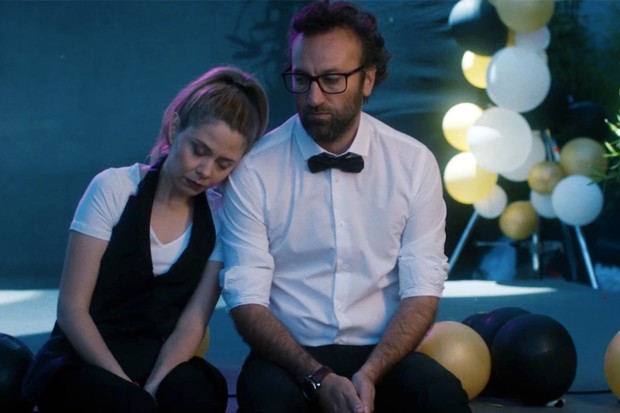
Our protagonist, Maja (Anja Matković, also the co-screenwriter), comes to the island on a very specific mission: to prove that the late sea captain Jakša was her father and to collect her fair share of her inheritance. Since the procedure can be lengthy, she decides to stay there for a while. The only option for her is to take a waitressing job at the only bar, owned by Mayor Ićo (Goran Navojec), which also comes with free accommodation. There, she meets an older US expat of Yugoslav origin, Saša (Uliks Fehmiu), who fancies himself as an aspiring writer and moved there for the nostalgic aspect of the place. A romance sets in, but his life situation is just as complicated as hers. As the summer season comes to an end and seemingly innocent incidents threaten to destroy the fragile “ecosystem” of human relationships on the island, all three will have some serious figuring out to do…

My Late Summer starts off strong and snappy, with rapid-fire jokes, but the director cannot maintain this pace, so he chooses to switch the tone first to romantic comedy, and then to (melo)drama, while frugally using what is left of the humour reserves to keep viewers at least mildly entertained until the end. Apart from Anja Matković, who was promoted to the big screen by Tanović in his previous film, and who really owns her character here, the rest of the actors, in supporting and episodic roles, are basically left in improvisation mode, so they opt for recycling their usual types with some minor variations to them, which just about does the job.

The splendorous production and craft values serve the film well. Miloš Jaćimović’s cinematography alternates between intermezzos of the picture-perfect Adriatic vistas and the seemingly floating hand-held mode that imitates the predominant state of mind on the island. The production design by Veronika Radman complements the locations perfectly, making My Late Summer an easy, watchable viewing experience. However, its low-risk philosophy and the fact that it runs low on fuel for the better part of the second half hinder its ambitions.

23.4.23

A Film a Week - Something Sweet / Nekaj sladkega

 previously published on Cineuropa


For a country with such a modest film output, quantitively speaking, Slovenia has a relatively long tradition of making independently produced films. Those movies might not always have been successful on the festival circuit or with international arthouse audiences, but they tend to fare better with a domestic crowd, attracting large numbers of viewers to movie theatres.

It might be significant that the director of the newest Slovenian indie crowd-pleasing comedy Something Sweet, Tin Vodopivec, started his film career as a production assistant on one of the most prominent Slovenian indies, Mitja Okorn’s Here and There (2004). In the meantime, Vodopivec has made a name for himself mostly as a stand-up comedian, so he teamed up with his partner, singer-songwriter and radio/TV presenter Urška Majdič, and assembled a cast of regionally well-known colleagues for his directorial feature debut. Having already racked up decent numbers domestically, it went into theatrical distribution abroad in neighbouring Croatia, with the potential to widen its reach to the whole region of the former Yugoslavia, and even countries all over the world with a significant Yugoslav diaspora.

The film opens with a parallel montage of a TV show host in North Macedonia making an introduction for and announcing his guest, the internationally acclaimed marketing guru Ace Majstorovski, and Ace (Macedonian-Slovenian actor and stand-up comedian Saško Kocev) himself having sex with a fan backstage. In the next scene, we meet another protagonist, a Ljubljana-based freelance event organiser called Kaja (Bosnian-Macedonian actress Jelena Jovanova), who sleeps in her car. Her ticket out of poverty is the event she is currently handling: Ace’s master class in one of the finest hotels in Ljubljana.

With Ace being late and even missing his plane, and Kaja sending goofy driver Neša (Serbian stand-up comedian Nikola Silić) to pick him up and drive him from Skopje to Ljubljana, she still has to improvise in order to keep her boss (Oriana Girotto) happy and her suspicious colleague/rival (Ula Furlan) at bay. When she notices that a hotel bartender, Gogi (also played by Kocev, this time with glasses and unkempt hair), is the spitting image of Ace, she gets the idea of making Gogi pose as Ace until the real guru shows up. With mess-ups on the road for one part of the gang and mess-ups with the flawed event organisation for the other, viewers will be treated to a few laughs and even a hint of romance blossoming between Kaja and Gogi.

The premise of deliberately mistaken identities is fairly standard for a screwball comedy, and Vodopivec tries his best not to mess it up. When he trusts his cast in front of the camera and lets them improvise, as well as the crew behind it, he does a decent job. The trouble arises when he decides to intervene with more attitude than actual experience in such things. Some examples of this are when he instructs editor Miha Šubic to employ some abrupt, quasi-jump cuts to ramp up the tension or use prolonged screen blackouts to highlight the significance of certain moments, or when he lets the score written by co-writer and composer Majdič and Leon First play in endless loops as a backdrop. The biggest problem, however, is the scriptwriting, with Vodopivec and Majdič sticking to the basics of shorter, TV-friendly scenes, relying too heavily on sketch logic and verbal and physical gags, while trying to connect them all in a semi-meaningful narrative necessary for a feature film. On top of that, not every joke lands properly, and some fail miserably.

Nevertheless, the breeziness of the picture as a whole and the presence of comedians from all over the region, as well as the naturalistic treatment of the differences in language and senses of humour, should please audiences from Slovenia to North Macedonia. After all, Vodopivec made the film for them, and they might as well see it as something sweet.


5.3.23

A Film a Week - The House With No Man / Nha Ba Nu

 previously published on Asian Movie Pulse


Tran Thanh is a popular Vietnamese TV-show host, actor and, from recently filmmaker who has found a formula that works, at least from the financial point of view, with the success of his debut “Bo Gia” (2021, co-directed with Ngoc Dang Vu). The recipe was simple: a family-themed comedy-drama with slight romantic overtones was released in the less-busy winter period and earned over 17 million dollars, mostly domestically and in the nearby territories. With his newest film, and his first solo directorial effort, “The House with No Man”, he upgraded the formula by amplifying the romantic angle and timing the release in the time of the Tet holiday (the fact that it is also close to the Valentine’s Day also helps), and it resulted in the income of 18 million dollars so far, before even opening outside Vietnam.

Originally titled “Nha Ba Nu” (translatable as “Grandma’s House”), the film follows the youngest daughter in a three-generational household, Nhi (Hyunh Uyen An), and her attempts at love and life. The household is commanded by her mother Nu (Le Giang) and the conservative and rough “management style” she employs in the house is similar as the one she employs in the family-owned crab restaurant. Nhi wants to make a career as a designer, but she has to work as a server there, together with her sister, while the brother-in-law (played by the director himself), the only man in the house, but certainly not the man of the house, does the deliveries. The loving grandmother is there to provide some much needed support for the young women.

The things get complicated when Nhi is introduced to the young, rich and handsome John (Song Luan) through her friend. The two fall in love with each other, but the problems occur in the form of their parents. Nu is distrustful towards men in general and John’s parents are basically snobs who reject Nhi because of her class. On top of that, they already met her: she accidentally spilled soup over them in the restaurant. Can love conquer everything once they lose their support network: Nhi her family and John his parents’ money?

No matter how adept Tran Thanh as an actor is, he is still pretty green as a filmmaker, which is one of the core problems with “The House with No Man”. Firstly, the script written by Nguyen Huu Tuong Vi is far from perfect: dialogue-wise, it is too clumsy and it heavily relies on the tropes of the genres it adopts and sheds way too often. Sometimes it is refreshingly counter-intuitive, but more usually it feels like a missed opportunity. For instance, when this Romeo-and-Juliette-type of story takes a turn, we do not get to see a serious story about a young couple trying to make it on their own, but an equally rigid, cliché-ridden melodrama.

The feeling of intensity and extremity is amplified by the equally clumsy directing that aims for exaggeration of basically everything the movie consists of. The music is almost omni-present and always along the lines of the topic of a singular scene. Colour scheme of Saigon in the festive Tet times is beautiful, but camerawork is usually too busy. The actors always work in a through-the-roof emotional register. Finally, the treatment of the film genres is quite simplistic: comedy is on the verge of slapstick, romance feels phony and melodrama comes dangerously close to the realm of involuntary parody with its over-the-top sentimentality.

However, low-brow as it is, “The House with No Man” will have absolutely no trouble finding its audience among those who are looking for a family friendly comedy-drama covered in a thoroughly sanitized romance. But the critics will prove to be a tougher nut to crack.


13.8.22

A Film a Week - Even Pigs Go to Heaven / Nosila je rubac črleni

 previously published on Cineuropa


We already know that all dogs go to heaven, but what about pigs? They are among the most intelligent animals, somewhat trainable, but they also have strong personalities and can certainly be adorable in movies. So, 27 years after George Miller’s Babe, let us meet another very special pig, this time from the Zagorje region in Croatia, in the third feature film directed by the Croatian-American filmmaker Goran Dukić, best known for his debut, the American indie film Wristcutters: A Love Story (2006). Even Pigs Go to Heaven premiered in the national competition of the Pula Film Festival, and its next festival booking is just around the corner, at Motovun.

Narrated by the all-knowing Jesus Christ on the cross, and set in the hilly area of Zagorje (north of Zagreb) in the year 1991 when the war broke out in Croatia, Even Pigs Go to Heaven plays out like a light-weight comedy-drama about pigs and their human companions dealing with the hardships of life, love and the well-meaning but sometimes overbearing environment. Our human protagonist is Anka (Nataša Dorčić of You Carry Me fame), a smart and energetic village woman that has to handle various situations on the verge of scandal. Firstly, her goddaughter Ančica (Tesa Litvan) is about to get married to a hopelessly naive and seemingly mentally challenged man she does not love, while she carries the baby of the village priest in an environment where everybody knows everything and everybody judges everyone, but where discretion is an imperative of sorts. And secondly, her beloved sow Beba (voiced also by Litvan) really has the itch to mate for the first time. Anka has Rocky, a dark-haired, big and strong boar in her mind as a perfect match for Beba, but the trouble is that Rocky is Serbian and what would the village think of her while the young lads get mobilised into the army to fight against the Serbian aggression?

Silly as it seems, Even Pigs Go to Heaven is actually a love letter to the unique landscape and the unique mindset of Zagorje that combines religiousness, alcohol, hard work and humour with some of the nasty habits of gossiping, being judgmental and getting in conflicts with neighbours, friends and family members for various petty reasons, masked by a blend of sex, romance and the comedy of human nature that sometimes turns into a proper drama. Spiced up with emotions, decorated with cutesy animation and dressed as a period piece, detailed in terms of music and sound design, this film is certainly a demanding production that manages to keep the local taste while telling a universally understandable story.

The script written by Sandra Antolić (Branko Schmidt’s Agape and Once We Were Good for You) is quite detailed, rich in local flavours regarding customs and the dialect, while the basic story of human and animal love as overseen by a benevolent figure works in pretty much any language, both as a folktale and as an observation of human behaviour. Nataša Dorčić carries the film with zest and grace. On the technical level, everything is a top notch effort, like Branko Linta’s postcard-worthy cinematography, Iva Rodić-Novak’s production design, Morana Starčević’s costume design, animation and visual effects done by the co-production company Vertigo Visual and especially Ivana Fumić’s smooth editing, while the soundtrack consisting of jazzed- or rocked-up traditional songs (and those newly written that sound traditional) by the band Cinkuši is absolutely fitting. It seems that Even Pigs Go to Heaven was a meaningful project for all involved and that Dukić, who can certainly make a cute, feel-good yet extravagant film, also had a good time directing it.


27.3.22

A Film a Week - Far Far Away / Yun lou saan go lo

 previously published on Asian Movie Pulse


Amos Why got some notoriety with his debut feature, the romantic drama “Dot 2 Dot” (2014) which revolved around a girl who came to Hong Kong from mainland China and got fascinated by the place’s culture. His next film was “Napping Kid” (2018), a tech thriller with some political undertones that ultimately suffered from the convoluted plot.

Why is back to the romance genre with his latest work, “Far Far Away” based on a simple premise of a shy and nerdy IT guy who all of a sudden draws the interest of five different good-looking girls. The film premiered at the last year’s edition of Hong Kong Asian Film Festival, while its theatrical release was scheduled for this year’s Valentine’s Day. We caught it at Osaka Asian Film Festival, where it had its international premiere.

Hau (played by very charismatic Kaki Shum) is a 28 year-old computer geek who worked as a developer of a dating app despite his dating history is short. Once he gets the courage to ask his pretty co-worker (Cecilia So) out, the whole new world opens up to him. At the preparations for his friends’ wedding, he meets the “professional bridesmaid” Fleur (Crystal Cheng) who feels pressured to get married and have kids herself soon and also Lisa (Hanna Chan) on whom his high school friends all have crush. A chance encounter with Mena (Rachel Leung) who has the same car (brand, model and even colour-wise) as he does results in a fling. And finally, there is also his college friend Melanie (Jennifer Yu) he feels very comfortable around.

Apart from dealing with Hau’s prolonged growing up, Why also deals with the geography and contemporary life, including also social, economic and toned-down political aspects, in Hong Kong. The reason for that is that all the five girls live in different remote corners of Hong Kong, and the sheer “geography” is one of the reasons why keeping up a relationship with any one of them demands some compromises on Hau’s side.

Far Far Away” starts pretty much as a basic romantic flick with some attempts at broad comedy, laced by forced structure (the first half of the film is divided in chapters called “lessons”), stereotypically underwritten characters (the nerdy guy is simply too nerdy, while the pretty girls are approaching the movie star-level of prettiness) and even predictable directing in which Why tries to overcome the blandness with some flashiness in the graphics department and the mandatory slow-motion entries. Even the more appealing local aspect seems aimed at the local audiences and connossieurs of Hong Kong’s layout, while the outsiders could remain confused with bits and pieces of data Why feeds them with.

Luckily, it gets better later on in almost every aspect once the structure is dropped and the plot starts evolving more freely. The romantic and other issues feel more organic and even the directing style loosens up, replacing the endless reverse shots from the fixed positions in conversational scenes with controlled camera movements. Even the predictable gentle pop tunes make more sense. That way, the viewers can appreciate not just the story, but also the details in the background of it, the inter-personal dynamics between the friends and love interests and the numerous details of the Hong Kong culture and way of life, making the film actually more of a love letter to the city than a story of one’s search for true self through the relationships.

What works best here is casting. Why deliberately chose his cast from the ranks of the younger up-and-coming actors and actresses who might not be as recognizable as the bigger stars, but who make up for it with their youthful energy and compelling chemistry in the scenes they share. Finally, “Far Far Away” is quite an enjoyable little movie.


20.1.19

A Film a Week - Didi's Dream / "Chi chi" de ai

Reading the IMDb description of Kevin Tsai’s directorial debut, a person can jump into conclusion that Didi’s Dream is yet another riff on the romcom genre riddled with tropes of a woman of a certain age, her not so perfect life and relationship, family ties and the sudden nature of success and illness. Honestly, it a bit clichéd and all the ingredients are well known, used and reused, but there is something fresh about this particular story and the freshness of it is obvious right from the start.

The start is, however, a titular dream in which the titular character is Xu Chunmei, the owner of an intergalactic noodles diner in a space-opera version of the future where even soups have ability to adjust themselves automatically according to the taste of the costumer. Pretty cool, right? But in her Earthly life, Shangguan Didi (Dee Hsu) ia a wannabe actress who keeps auditioning (those scenes are as hilarious as they feel constructed and over the top) only to get the extra roles and the non-speaking parts in moronic commercials. Her boyfriend Kouzi (Jin Shijia) is as supportive and as modest as they come, but Didi wants more from life. Her driving force seems to be a fierce rivalry with her sister Lilgling (Chiling Lin of Red Cliff moveis fame), a successful star-actress and nationally beloved celebrity.

The things change in one lucky and one unlucky break that happen simultaneously. As she gets her terminal brain tumor diagnosis with only one more year to live, she also gets a series of silly parts for television that slowly but steadily propel her to fame, first as a viral video comedy sensation and then as a bona fide celebrity that gets to play in a period piece drama (or it may be a wuxia thing, we are never sure) alongside her sister. Will Didi have enough time to prove herself to herself and to the others?

It is a familiar story told in an interesting and inspired way. Tsai’s sense for staging and directing particular scenes (especially those dreamy ones) is strong, albeit his overwhelming use of loud score, while the script he penned together with Mingyi Liao feels inspired due to a number of well-placed comedic moments. Originally a screenwriter with a couple of credits to his name in the 90’s, Tsai made his name recently as a TV host on the show called Kangxi lai le and a judge on another one, U Can You BB. That shows in his knowledge of the mechanics of popular, even a bit trashy television and he, apparently, draws a lot of references from there and even does the cameo-casting from the pool of his regular guests. Some of that, however, gets lost in translation for the viewers (such as myself) who are not the avid watchers of Taiwanese and Chinese television.

Even his principal actress Dee Hsu comes from that milieu and Didi is her big screen debut. For her work here, she could be considered a major discovery, since her comedic timing is perfect and her general spunkyness serves the role quite well. She definitely lifts Didi’s Dream a couple of levels above the standard-issue, stereotypical romantic comedy, while maintaining it both romantic and humorous notwithstanding the film’s occasional milking for emotions via cheap sentimentality.

22.10.17

A Film a Week - How to Talk to Girls at Parties

originally published on Cineuropa
The idea of aliens meeting punk-rock teenagers in 1977 Croydon, London, seems outlandish, but it is actually the subject of Neil Gaiman’s short story adapted for the screen by Philippa Goslett and John Cameron Mitchell, who is also the director. How to Talk to Girls at Parties, shown in the Sitges International Fantastic Film Festival’s New Visions One programme, crams a lot of ideas, tropes and genres into the mix. Basically, it is a coming-of-age romantic comedy, science-fiction fish-out-of-water comedy, and a kind of musical period piece dealing with the subjects of young love and conformity versus individuality. All of that blended together should not theoretically work that well, but somehow it does just enough to make it a pleasurable film experience with the potential for a cult following in the future.
Our protagonist, Enn (young Broadway actor Alex Sharp in his first screen role), spends his days editing a fanzine and hanging out with his two friends Vic (AJ Lewis) and John (Ethan Lawrence). After a gig they attend in the den of punk queen Boadicea (Nicole Kidman) goes awry, they get lost on their way to an after-party, ending up in a house inhabited by a crew of aliens with human masks who are on a research mission. It is here that Enn meets Zen (Elle Fanning), a curious girl who wants to get away from the party and do some surveying on her own. Since she is attracted to Enn, she is about to learn a great deal about punk music, culture and attitude. And so the adventure begins!
How to Talk to Girls at Parties works so well in its sheer ridiculousness mainly because of its fast pacing with a lot of snappy dialogues, and the sense for period details laced with campy aesthetics. Plus, it also features some of the funniest jokes this year, such as Zen’s first kiss with someone always being followed by vomiting, aliens dressed in Union Jack raincoats, like stereotypical naive tourists, and punk teens assuming that the alien crew is a Californian cult. A lot of attention has been paid to details such as recreating Gaiman’s detailed alien class system and society structure, which has been achieved by means of colour-coding and superb animation sequences. The whole lore is incorporated efficiently into the script, making the rhythm smooth. The casting of the leads is also spot-on: Sharp is compelling as a young punk enthusiast, while the role of a curious alien suits Fanning perfectly.
However, not all of the aspects of the film are so successful. Kidman overacts her role of a punk elder, mistaking it for campy charm and letting her accent drift from Cockney to Aussie and back again. In addition, the whole punk scene remains superficial for the duration of the running time, reducing the movement to several worn-out clichés and name-dropping of bands and artists, which is strange, given that John Cameron Mitchell is the filmmaker behind one of the most iconic punk movies of all time, Hedwig and the Angry Inch. Finally, the tonal shift in the third act from pure fun to something more serious seems fairly abrupt but is also somewhat predictable in accordance with the template of an aliens-studying-Earth comedy. None of this weighs down the film too much, however, and How to Talk to Girls at Parties brings just enough heart-warming fun to its viewers.